


Aylin Yazıcıoğlu: From Academia to Sardines in Vine Leaves
Aylin Yazıcıoğlu’s story as a chef does not begin at culinary school. It begins at Cambridge. After graduating from Galatasaray High School, she studied sociology at Boğaziçi University. She wanted to become an academic, and that path eventually took her all the way to a PhD at Cambridge University.
Then, one day, she fell out of love with academia. Of course, you don’t simply wake up one morning in the third year of a PhD at Cambridge and suddenly say, “I’m going to become a cook.” In Aylin’s own telling, the decision did not happen overnight either. At some point, she asked herself a very simple question: Do I still want to be doing this ten years from now? The answer was no. But food was already part of her life by then.
And this is not the story of a solitary PhD student shutting herself away in a kitchen. Quite the opposite. Her interest in food grew around friends, companions, long tables and long conversations. When Aylin talks about those years, she says that a kitchen feeds not only the stomach but also the soul, and that the conversations and friendships built around it give us something that goes far beyond the food itself.
Perhaps this is why the move from sociology to the kitchen is not as radical a break as it might first appear. In one, you try to understand people, relationships and society. In the other, you bring them together around the same table. To find out whether her decision was just a romantic impulse, she first took a job at the very bottom of the hierarchy in a pub kitchen in England serving Thai food. She was 36. She worked there for about a month. By her own account, the kitchen was so bad that she figured if working there hadn’t put her off the profession, very little ever would.
Then she went to Paris, to Le Cordon Bleu. What followed were years working in different kitchens. Jean-Charles Rochoux, Alain Senderens, Stéphane Glacier, Hispania Barcelona, Couvert Couvert in Leuven and Asador Etxebarri were all part of that journey. Having entered professional kitchens in her thirties, she tried to make up for what she saw as lost time, even spending her holidays staging in other kitchens.
In 2013, she returned to Türkiye and opened Nicole with Kaan Sakarya. She left the restaurant she had co-founded shortly before Nicole received its Michelin Star.
Today, among Novavera’s olive groves in Ayvalık, she is doing something else. And for me, this is where the most interesting part of that long story begins.
Because when I look at Aylin Yazıcıoğlu’s cooking at Novavera, what interests me most is not the olive oil. It is the chef’s intention.
From Olive Oil to Food
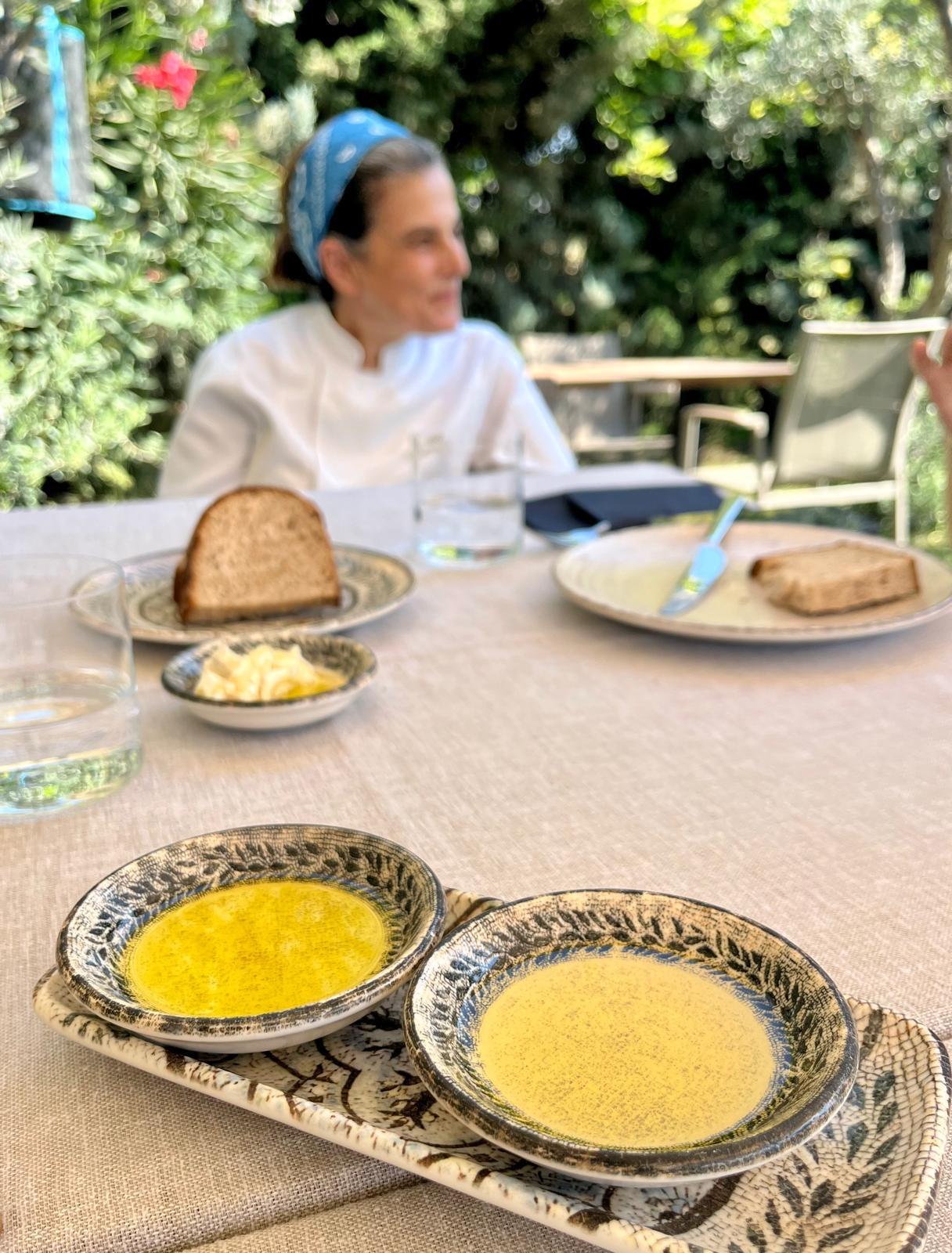
Novavera was not born as a restaurant. We are in the middle of the olive groves and production facilities of an olive oil producer in Küçükköy, Ayvalık, shaped in large part by Bahar Alan. The olive tree, the olive itself, the facility where the oil is produced, and, finally, the food all come together in the same place. Naturally, this gives Aylin an extraordinary environment in which to work.
Olive grove → olive variety → olive oil → food.
Different dishes are paired with different Novavera oils. The oil is not a condiment added at the table as an afterthought. It enters the equation while the very idea of the dish is still being formed. But for me, the real question is not how good Novavera’s olive oils are. Because you can buy excellent olive oil. You can find excellent tomatoes. You can find extremely fresh sardines. None of these things, on their own, make good food. You still need a chef in between. A chef who knows not only when to touch the ingredient, but also when to leave it alone. I think that is exactly what Aylin is doing here.
Almost every dish has a gastronomic idea behind it. But we fell in love with two of them.
Sardines in Vine Leaves
The Summer ’26 Öğleden Akşama (from afternoon to evening)
menu is not very long. We started with a tomato salad and a purslane salad, followed by pastrami, grilled sardines in vine leaves, and two of the three items listed on the menu as “pide.”
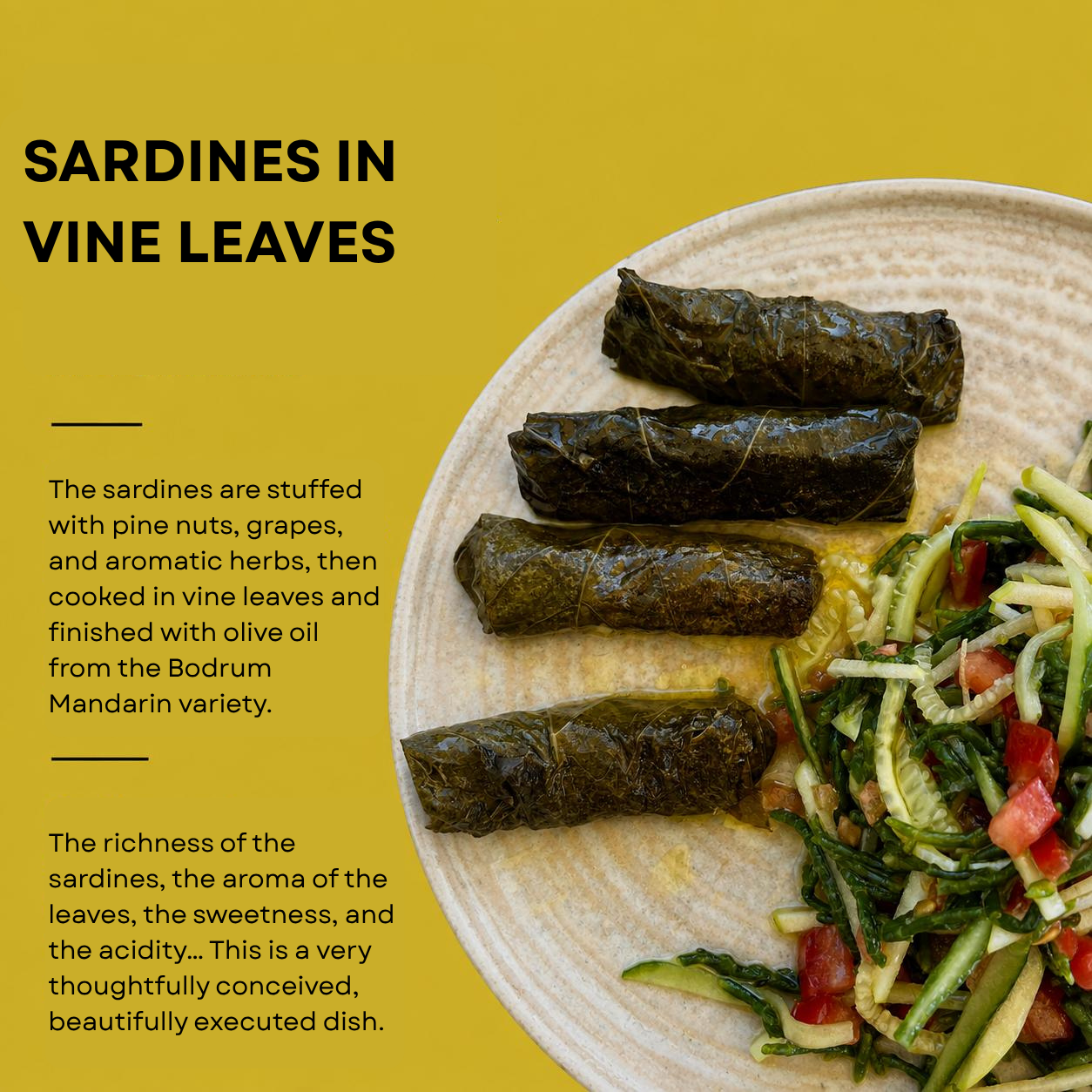
There is a gastronomic idea behind almost every dish. But we fell in love with two of them. The first was the grilled sardine in vine leaves. The sardine is stuffed with pine nuts, grapes, and aromatic herbs, wrapped in a vine leaf, grilled, and finished with Novavera’s Bodrum Mandalina olive oil. On paper, it almost sounds too familiar.
Sardine, Vine leaf, Grapes, Pine nuts, Herbs, Olive oil…
None of these ingredients is exotic in the Aegean. None of them is particularly surprising on its own. Then you eat it. And something completely different emerges.
The sardine’s own fat and intense taste of the sea, the slight bitterness of the vine leaf, the sweetness of the grapes, the texture of the pine nuts, the aromatic herbs and the olive oil do not pile on top of one another. They carry one another. More importantly, after all these interventions, the sardine is still a sardine. For me, this is exactly where the line lies between good cooking and unnecessary gastronomic theatre. You can surprise people by transforming an ingredient until it is no longer recognisable. It is much harder to leave a familiar ingredient essentially as itself and somehow make you discover it again.
Aylin Yazıcıoğlu has turned a sardine in a vine leaf into a gastronomic masterpiece. I don’t use that expression lightly. But this dish deserves it.
Pastrami
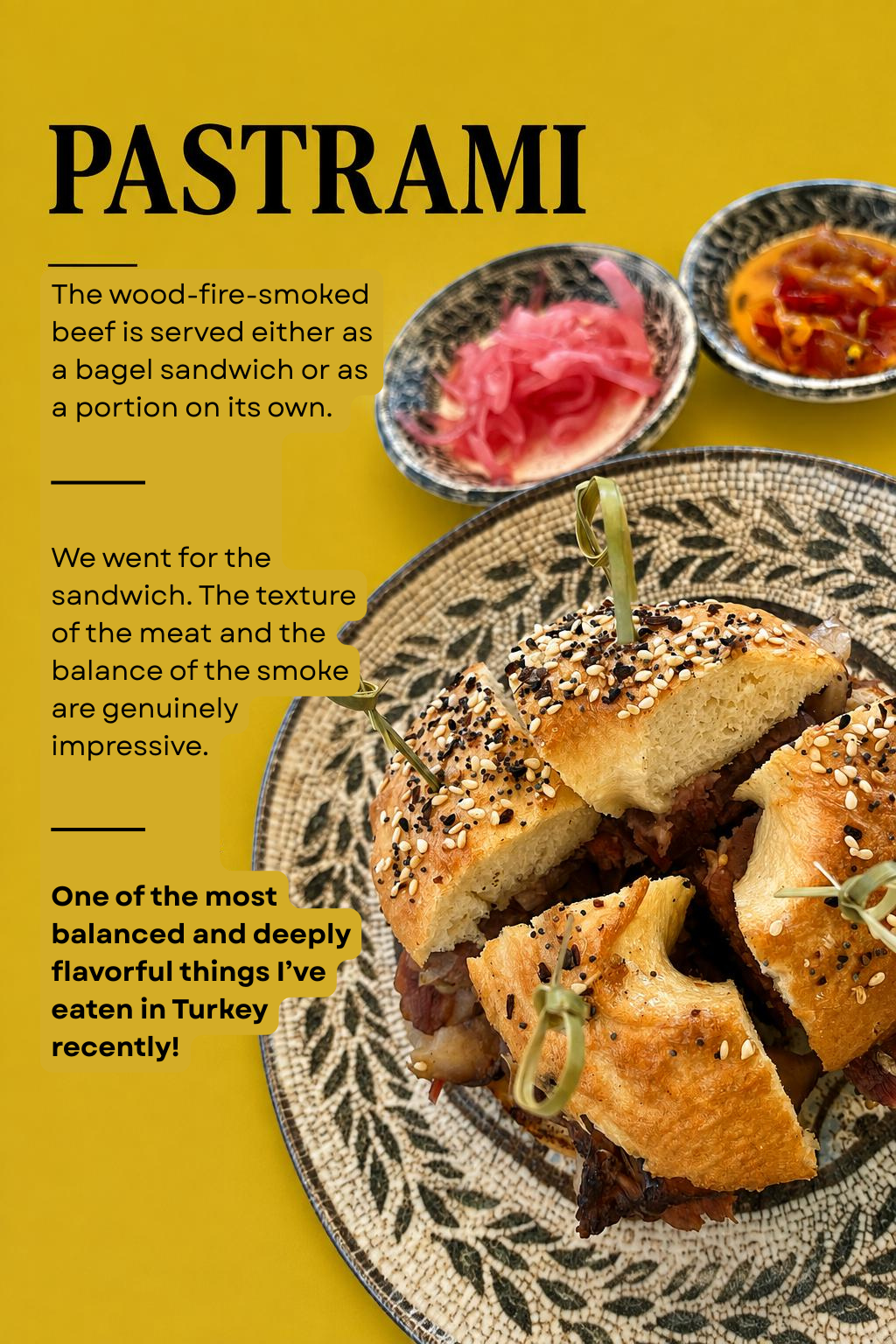
Our other favourite was the pastrami.Wood-fire-smoked beef is served either as a bagel sandwich or on its own. We had it in the bread. There is the same restraint here. There is smoke, but it doesn’t cover the meat. Quite the opposite, it deepens its flavour. The texture of the beef is excellent. When the bread, meat and accompanying pickles come together, nothing is trying to push its way ahead of everything else. The result is one of the most balanced and deeply satisfying things I have eaten in Türkiye in quite some time.
These two dishes alone are reason enough to return to Novavera.
Pide or Pizza?
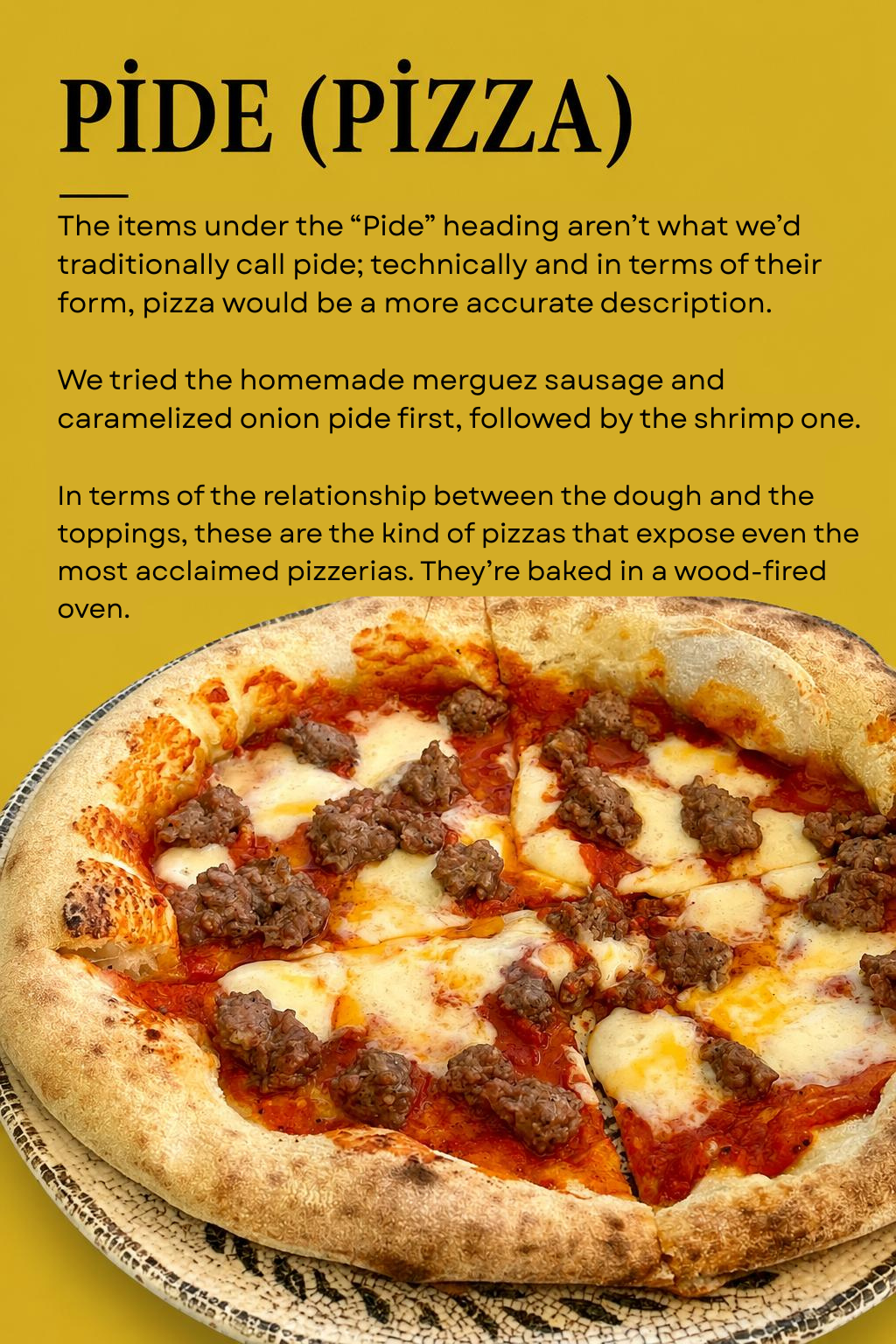
I do, however, have an objection to the things listed under “pide” on the menu. I don’t think these are pide. They are pizza. And very good pizza at that. We tried the one with house-made merguez sausage and another with shrimp, kelle cheese and garlicky tomato sauce.
They are baked in a wood-fired oven. The dough is well fermented. The edges rise beautifully, developing a strong crust on the outside while retaining moisture inside. The toppings don’t overwhelm the dough either.
When I think about some of the fashionable pizza places that have opened in recent years claiming to serve “good pizza”, whose interiors and social media accounts have gradually become more ambitious than their pizzas, there is something rather funny about it.
The “pide” at Novavera, which Novavera doesn’t even call pizza, is good enough to expose quite a few of them.
The Chef’s Intention
Part of what makes Novavera interesting is, of course, the fact that you are eating right next to the producer.
The olive grove is a few steps away. The facility where the oil is made is on the same property. Oils made from different olive varieties enter the kitchen and are used according to the character of each dish. But after eating all of this, what stayed with me more than Novavera’s olive oils was Aylin Yazıcıoğlu herself. Because what is happening here, to me, is something more than a simple “producer-to-plate” story.
A chef who fell out with academia at Cambridge, tested herself at 36 by starting at the bottom in an English pub kitchen, then went to Paris to learn cooking formally, spent years working in different kitchens across Europe, and eventually returned to Türkiye to build a kitchen of her own has now arrived somewhere surprisingly simple.
A sardine, a vine leaf, a few grapes, pine nuts, herbs, and olive oil.
All that education, the Michelin-starred kitchens, the techniques and the years of work are being used not to put more things on the plate, but perhaps to understand what does not need to be there. That is what I like about Aylin’s cooking. There is technique, but no display of technique. There are excellent ingredients, but no need for a long speech explaining where every one of them came from. There is an idea, but you don’t need an interpreter standing beside the plate to explain that idea to you. The food speaks for itself.
And sometimes, to understand how good a chef really is, you shouldn’t look at how many things they can put on a plate.
You should look at what they can do with so little. Ayvalık was already a place worth travelling to for food. Now there is another very good reason to go: To see what Aylin Yazıcıoğlu is cooking.
