


Good Despite Michelin: Roka Bahçe
We wandered through the streets of Alaçatı before eventually arriving at Roka Bahçe. Stone houses, beautifully preserved façades, magnificent bougainvillea spilling over walls and balconies, cats quietly roaming between doorways and tables… Alaçatı is still beautiful. And this time, the crowds we had grown accustomed to in previous years were gone. In places, the streets were almost surprisingly quiet.
Yet walking through them is still not easy. The space left behind by the crowds has been taken over by tables. Restaurants and bars have spread their tables and chairs so far into the streets that, at times, there is barely enough room for two people to walk side by side. You pass beneath a bougainvillea, step around a cat, then squeeze past the edge of yet another table. Winding our way through these narrow streets between Alaçatı’s beautiful stone houses, streets that have become part public space, part restaurant dining room, we eventually reached Roka Bahçe in Hacımemiş.
Roka Bahçe is hardly a newcomer to Alaçatı. Gökhan Safkan opened the restaurant in 2010, and it has been here for sixteen years. Safkan’s own story goes back further. His long career in restaurants began in Istanbul with Şarabi before eventually moving to the Aegean. At Roka Bahçe, the seafood, herbs and meze tradition of the Aegean sit alongside the Bosnian cuisine of Safkan’s family heritage. The pljeskavica on the menu, then, is not some Balkan dish added for variety. It is part of the restaurant’s story.
And then there is the Michelin question.
Roka Bahçe is Michelin Recommended. Anyone who follows United Plates will know that, particularly in Turkey, Michelin stopped being a positive reference for me some time ago. The previous evening, moreover, we had followed a Michelin recommendation to Kasap Fuat, an experience that, far from easing my doubts, only reinforced them. I certainly had no intention of following Michelin for a second consecutive evening in the same region. We went to Roka Bahçe not because of the guide, but because a friend whose palate I trust had recommended it.
I’m glad I listened to my friend rather than Michelin.
Because Roka Bahçe is, despite Michelin, a good restaurant. More importantly, it is a restaurant where the food tastes good.
I do not mean a kitchen hiding behind a handful of elaborate showpiece dishes. The menu is extensive, and we tried seven different dishes, excluding dessert. The seafood and meze tradition of the Aegean shares the same table quite naturally with the deeper, more robust flavours of Balkan cooking. On one side, tarama, octopus, cuttlefish and calamari; on the other, pljeskavica. In between are techniques, sauces and small touches borrowed from contemporary restaurant cooking.
Perhaps this is where Roka Bahçe’s real achievement lies. Not in Michelin having discovered it, but in the fact that it was here long before Michelin arrived. It has spent sixteen years in the same place, developing its own cuisine, its own language and, evidently, its own clientele. When we arrived, the streets of Alaçatı were quiet compared with years past, but there was not an empty table in Roka Bahçe’s garden. Every table beneath the bougainvillea was occupied.
Sometimes the strongest recommendation for a restaurant is not the Michelin plaque by the door, but a garden that is still full after all these years.
What We Ate
Let me give the overall verdict first: we found almost everything we tried delicious. The menu is broad, there are plenty of ideas, and there is technique on the plates, but what ultimately matters is that the food tastes good. For me, that is Roka Bahçe’s greatest strength. There were, however, a few dishes where we felt the kitchen might benefit from exercising a little more restraint, particularly with garnishes and flavoured oils, allowing the principal ingredients to speak more clearly.
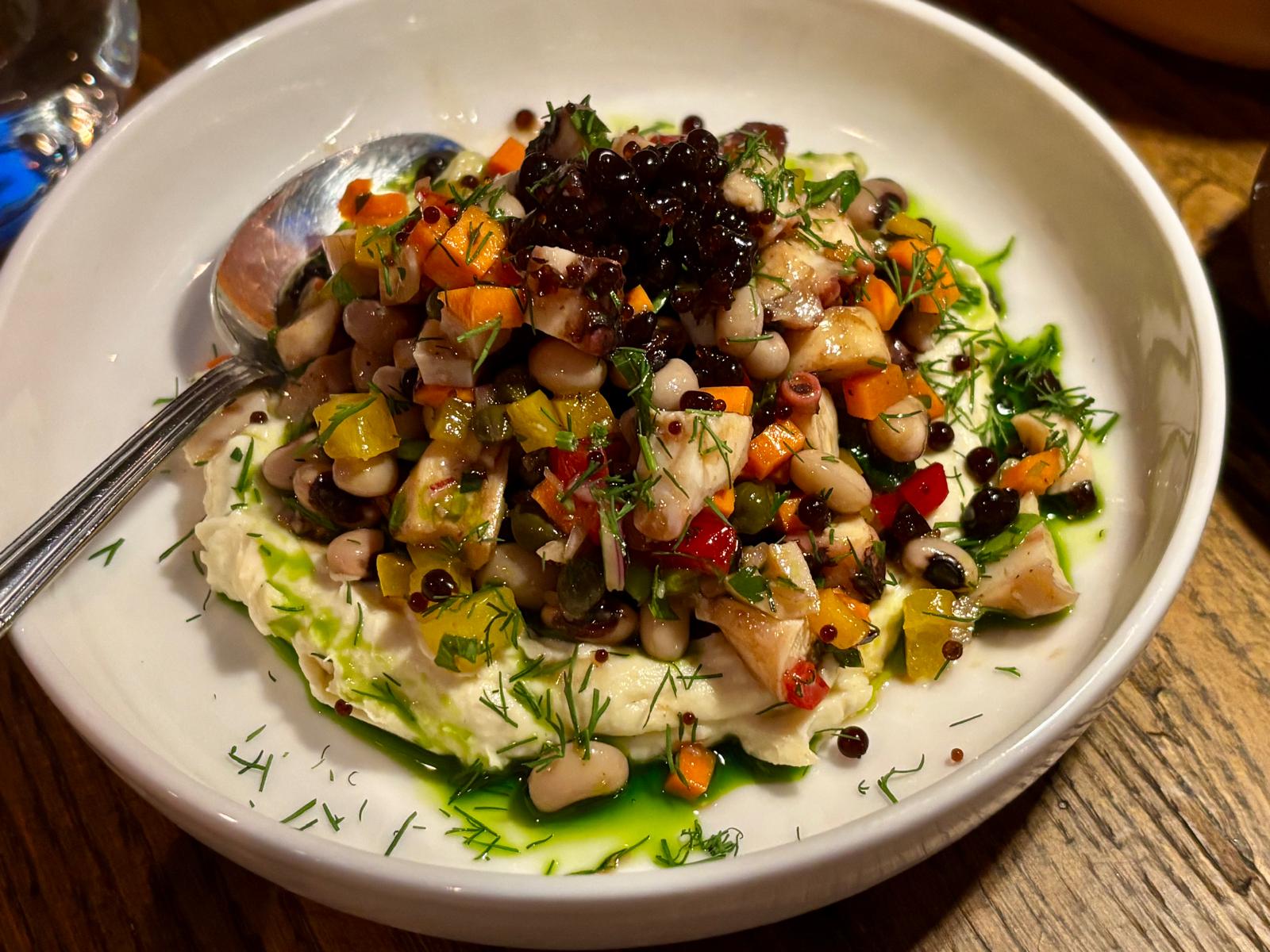
Octopus with Black-Eyed Pea and Artichoke Purée, Sour Cherry Vinegar
Octopus with Black-Eyed Pea and Artichoke Purée, Sour Cherry Vinegar
One of the best dishes of the evening. There was an excellent balance between the octopus and the black-eyed peas. Most impressive was that, among all these ingredients, you could actually taste the black-eyed peas themselves. They so easily become little more than bulk on a plate; here they did not. Their flavour remained distinct, their texture present.
The artichoke, unfortunately, was not treated with the same fairness. There was a fairly assertive amount of dill on the plate, beneath which the artichoke almost completely disappeared, reduced to little more than something that gave the dish volume. An injustice to the artichoke.
The dill, incidentally, is not mentioned in the menu description. I think it should be. Dill is not an herb like parsley that can quietly sit in the background. It has a distinctive flavour capable of changing the character of a dish. Those who love it tend to love it; those who do not, like me, notice it immediately. An ingredient this dominant deserves to be mentioned on the menu.
And then there was the parsley oil. Was it really necessary? The dish already had plenty to say through octopus, black-eyed peas, artichoke, sour cherry vinegar and dill. We struggled to understand what the parsley oil added in terms of flavour. These oils have become an easy and increasingly ubiquitous way of adding colour to restaurant plates. But they should not be there simply to leave a decorative streak of green. If something contributes nothing to the flavour, perhaps it does not need to be on the plate.
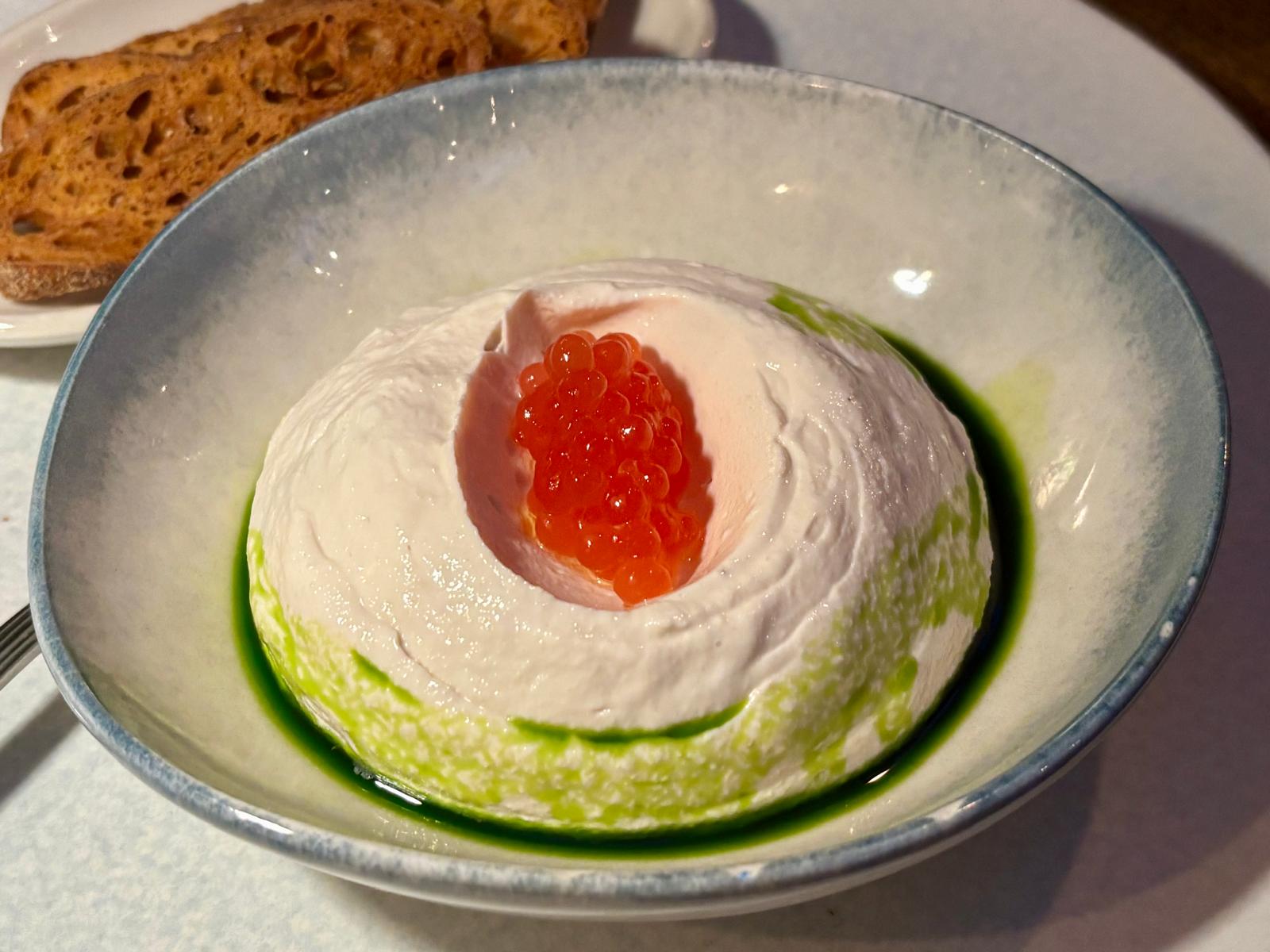
Whipped Tarama with Salmon Roe
Whipped Tarama with Salmon Roe
The tarama was also very good. The texture, intensity and taste of the sea were all there. We had only one small hesitation at the table: was it perhaps a little too salty?
And once again, there was parsley oil. We found ourselves asking the same question: why? Does it genuinely add another dimension to the tarama, or is it simply an easy, familiar way of putting some colour on the plate? A well-made tarama does not need the assistance of green oil to make its presence felt. Particularly in a kitchen that handles its principal ingredients this well, keeping some distance from fashionable and convenient sauces would not diminish the food. On the contrary, it might make it stronger.
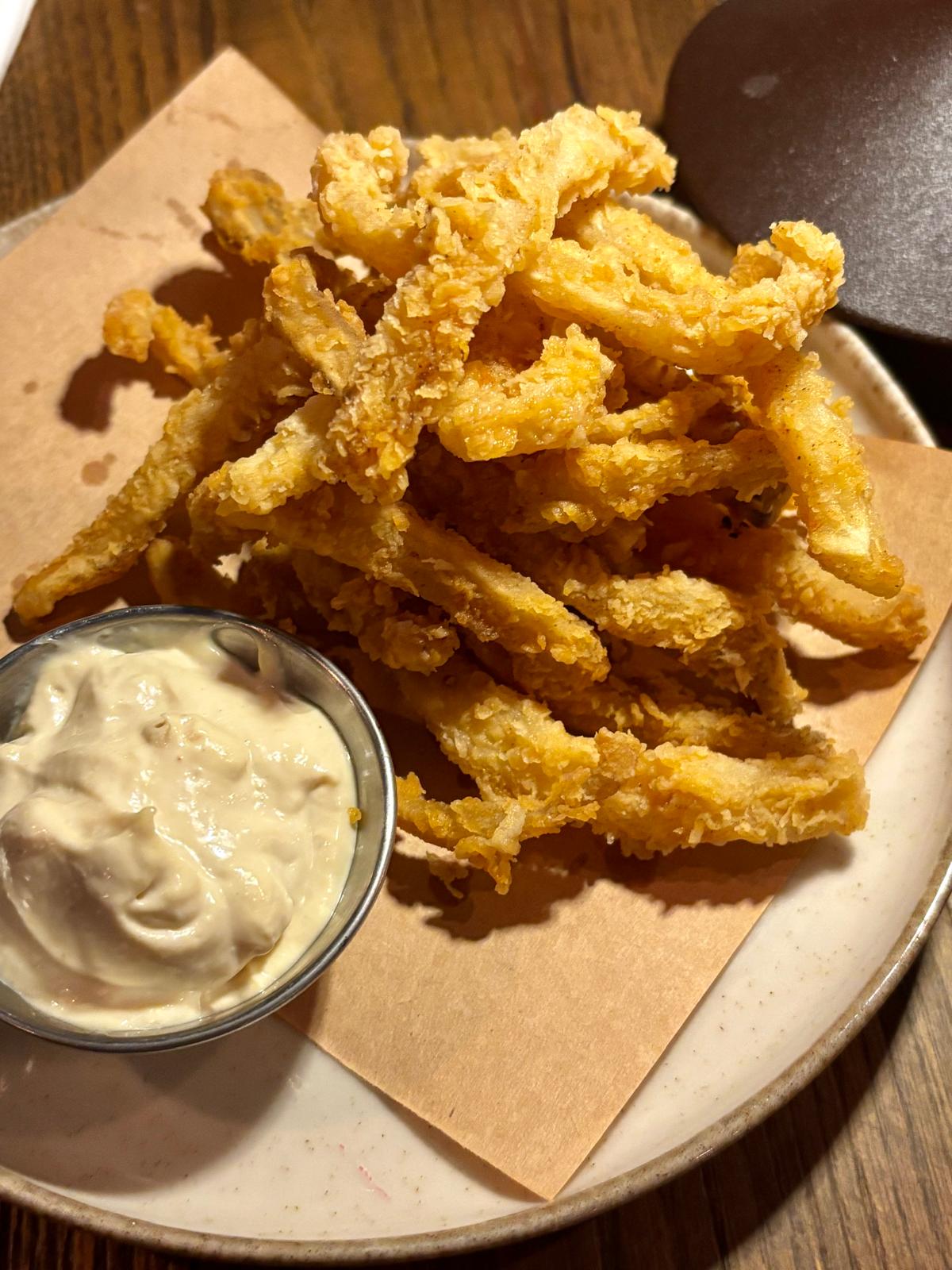
Fried Calamari Strips
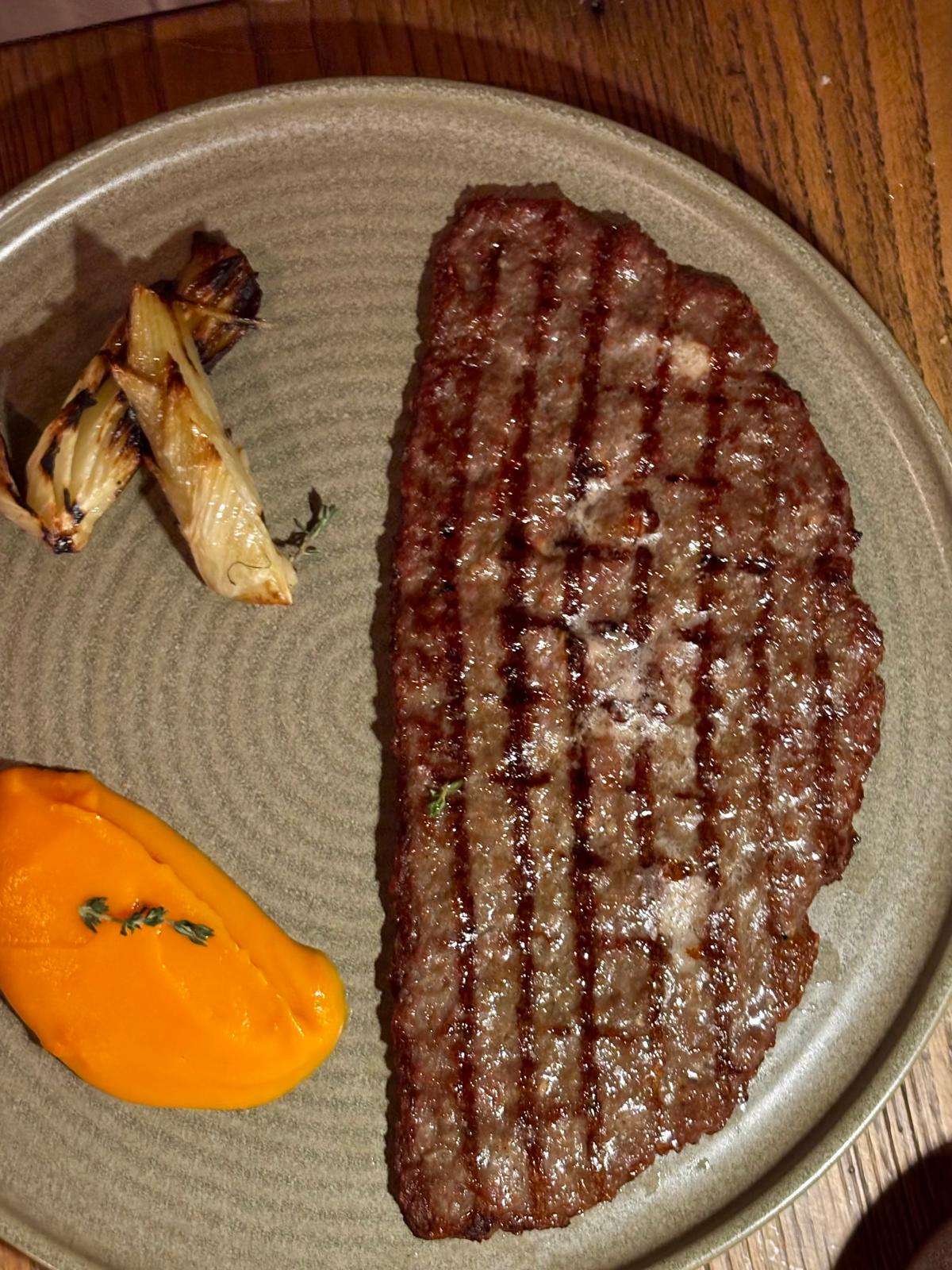
Grilled Bosnian Meatball, Pljeskavica
Fried Calamari Strips
There is little that needs to be said about the calamari: by Turkish standards, it was superb. Fresh, crisp and properly cooked. You could still taste the calamari itself; it had not disappeared beneath the frying. It is the kind of apparently simple dish that is remarkably easy to get wrong. Roka Bahçe got it very right.
Grilled Bosnian Meatball, Pljeskavica
Once you know about Gökhan Safkan’s Bosnian family background, you look at this dish differently. This is not a meatball placed on the menu to provide a little Balkan variety. It is food that comes from memory.
And what a memory. These days, it is difficult to find a pljeskavica of this quality even in Bosnia. The flavour of the meat, the balance of fat, the texture and the grilling were all excellent. This was not one of those increasingly standardised Balkan pljeskavicas that impress with their size but fail to do the same with their flavour. Roka Bahçe’s version reminded us why pljeskavica can be such a wonderful thing to eat.
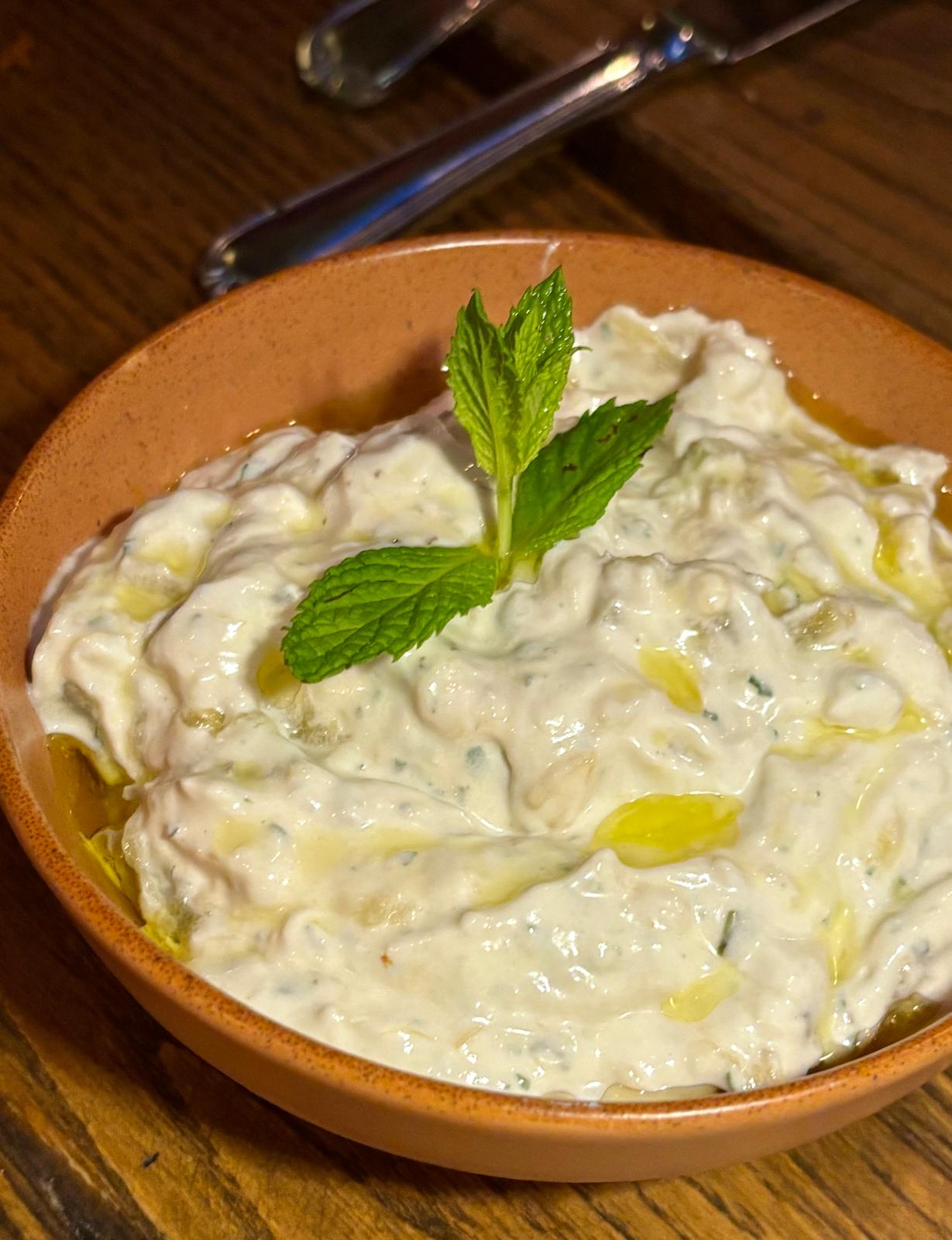
Mashed Eggplant with Tahini, Strained Yoghurt and Fresh Mint
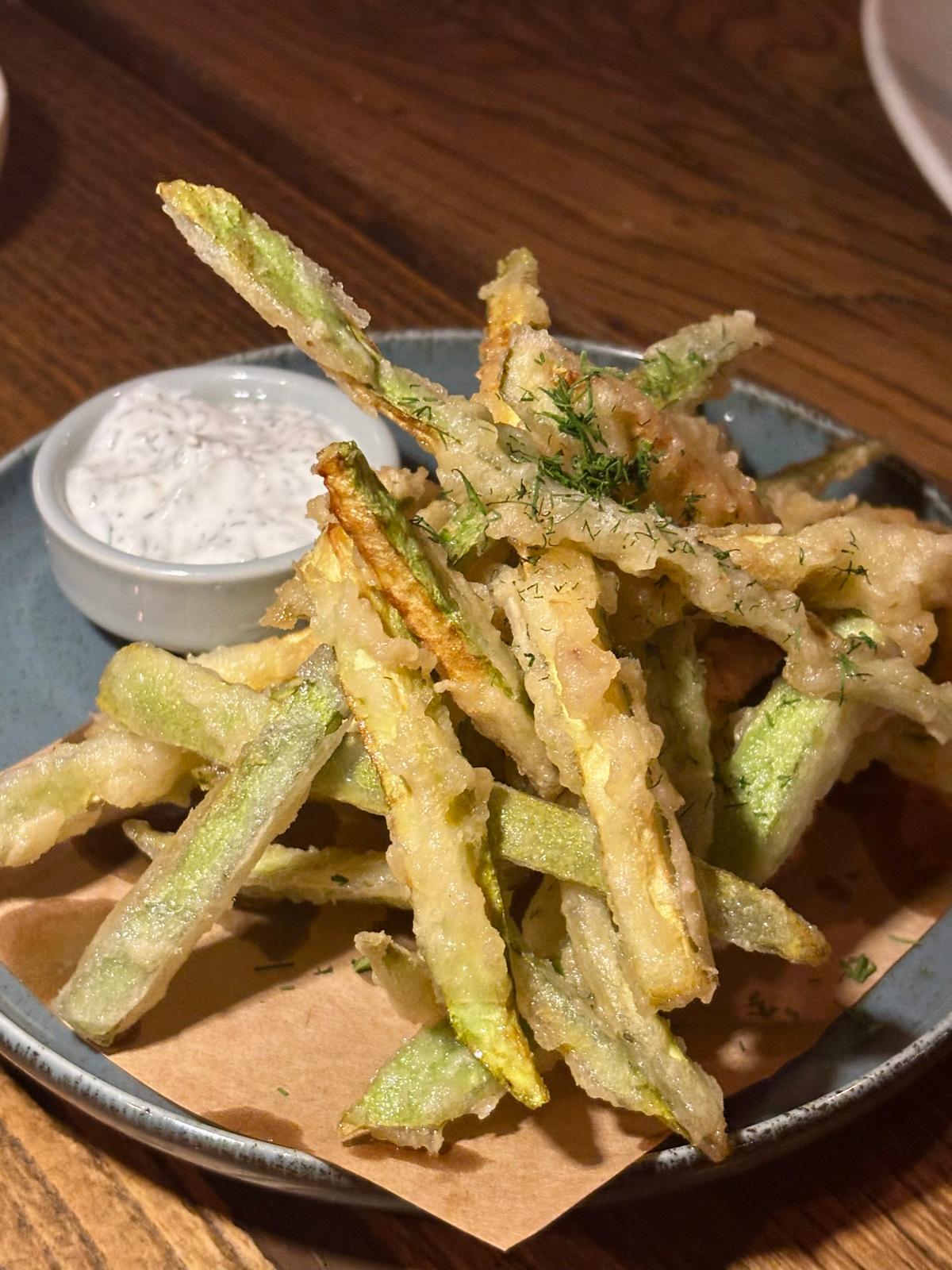
Crispy Zucchini
Mashed Eggplant with Tahini, Strained Yoghurt and Fresh Mint
One of the weaker dishes of the evening. The texture was delicate, but the flavour remained rather superficial. Perhaps that has something to do with my own expectations: in an eggplant purée, I look for that unmistakable smokiness of charred eggplant, and it was absent here. I had been expecting something different.
The fresh mint worked well with the eggplant and was perhaps the most distinctive element of the dish. But ultimately, very little remained in the memory. Compared with the strong character of the other dishes, where the ingredients were allowed to assert themselves, the eggplant purée felt rather muted.
Crispy Zucchini
A good plate of crispy zucchini. But when it comes to fried zucchini, the other side of the Aegean has already set the bar rather high. On many Greek islands, it is not difficult to find zucchini at this level, and with a really good tempura batter it is possible to go further still.
My personal benchmark, however, is Koço’s (Istanbul, Moda) zucchini, thinly sliced on the diagonal. It takes an apparently simple dish to another level in terms of texture and crispness. Roka Bahçe’s version was by no means bad. It was good. But for me, it remained below Koço’s.
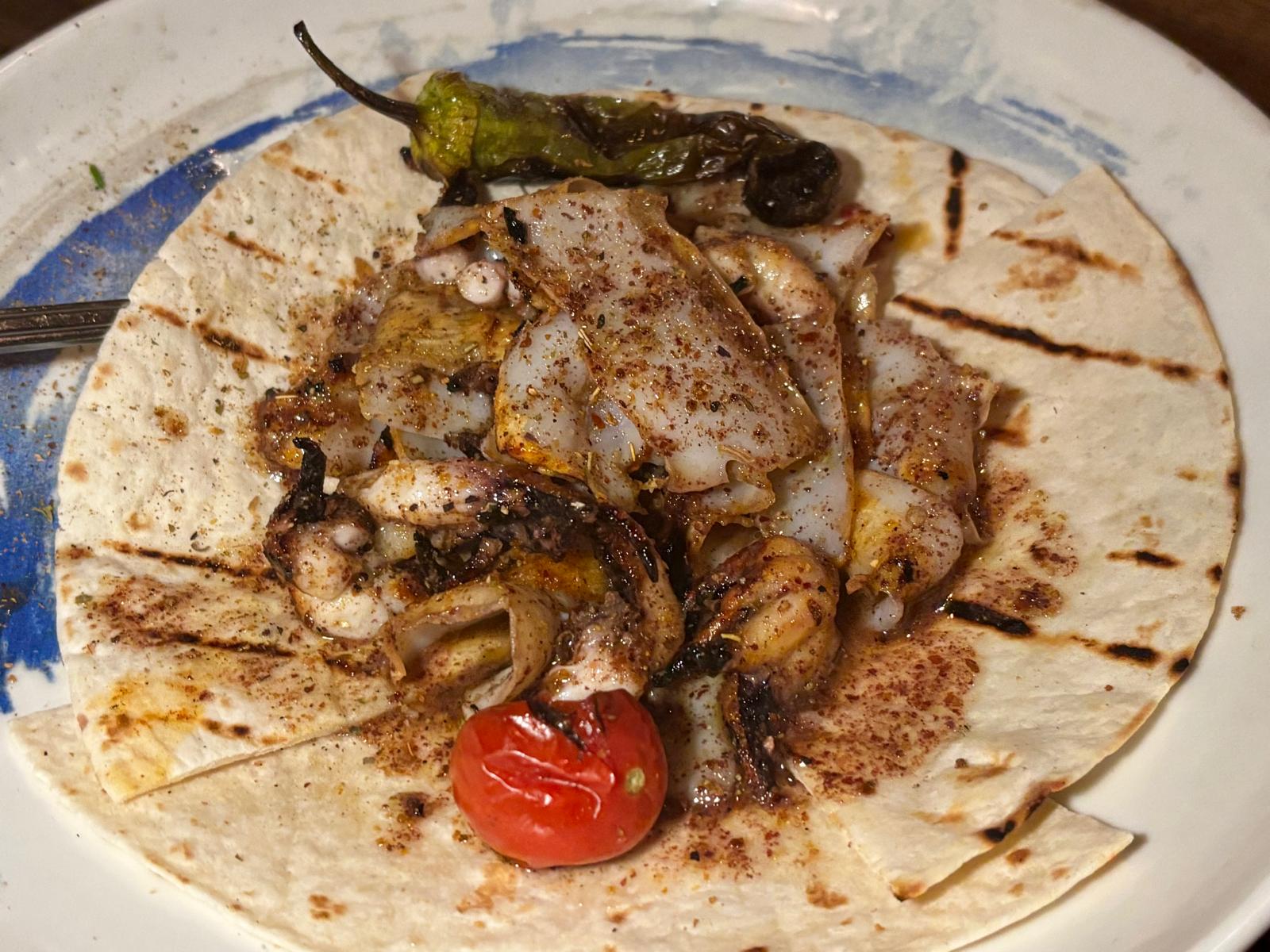
Grilled Cuttlefish Döner with Spices and Lavash
Grilled Cuttlefish Döner with Spices and Lavash
The best dish of the evening.
The cuttlefish was beautifully cooked. The seasoning, the texture and the way it worked with the lavash were so successful that rather than dissecting the dish in front of us and trying to analyse it, we simply wrapped it up like a dürüm and ate it. Sometimes that is the greatest compliment you can pay a good dish: you stop analysing and just keep eating.
It also made me think of something else. I wished we could have tried more dishes.
Because if the cuttlefish was this good, it was difficult not to imagine that somewhere in the parts of this extensive menu we never reached, there were other dishes at the same level. I left the table regretting not what we had eaten, but what we might have missed. What else was there?
This is where the sheer breadth of Roka Bahçe’s menu becomes a minor problem for a table of two. The meze portions are generous, easily enough for four people to share. With two people, you inevitably reach your limit after only a handful of dishes. They do not serve half portions either. When one of the great pleasures of a kitchen like this is being able to taste widely across the menu, the size of the portions makes that difficult for couples. Half portions would suit Roka Bahçe very well.
The service was good, too. And it remained so despite a completely full garden. The garden itself is an important part of the Roka Bahçe experience: busy yet pleasant, lively without becoming exhausting.
Prices are not low; they are above average. But neither are they outrageous. Looking around at the clientele in the garden, it is difficult to imagine these prices constituting a serious barrier for the restaurant’s core customers. There is something of Alaçatı’s class reality in this: a price being high is not necessarily the same thing as that price being expensive for the people paying it.
In the end, I left the table remembering the cuttlefish, the pljeskavica, the octopus and the tarama far more than the eggplant purée or the crispy zucchini. If you leave a restaurant thinking not “we shouldn’t have ordered that” but “I wish we could have tried those as well,” then the kitchen has largely done its job.
