


Parada Torres: From Three Michelin Stars to a Market Stall
Is fine dining dead? With Parada Torres, the Torres brothers offer a rather tangible response to one of gastronomy’s most fashionable questions.
The story of Sergio and Javier Torres has, from the very beginning, been intertwined with Michelin stars, haute cuisine and the discipline of that particular culinary world. At different stages of their careers, they trained within Europe’s grand gastronomic tradition, in kitchens associated with names such as Alain Ducasse. Their paths later converged again; Michelin stars followed at Dos Cielos, before they eventually reached the summit with Cocina Hermanos Torres, earning three Michelin stars. Today, Cocina Hermanos Torres remains one of the restaurants Michelin rates with its highest distinction.
So the two men behind Parada Torres are not simply celebrity chefs who happen to hold three Michelin stars. They are two cooks whose professional lives have been spent, almost in their entirety, within the Michelin-starred system.
Parada Torres
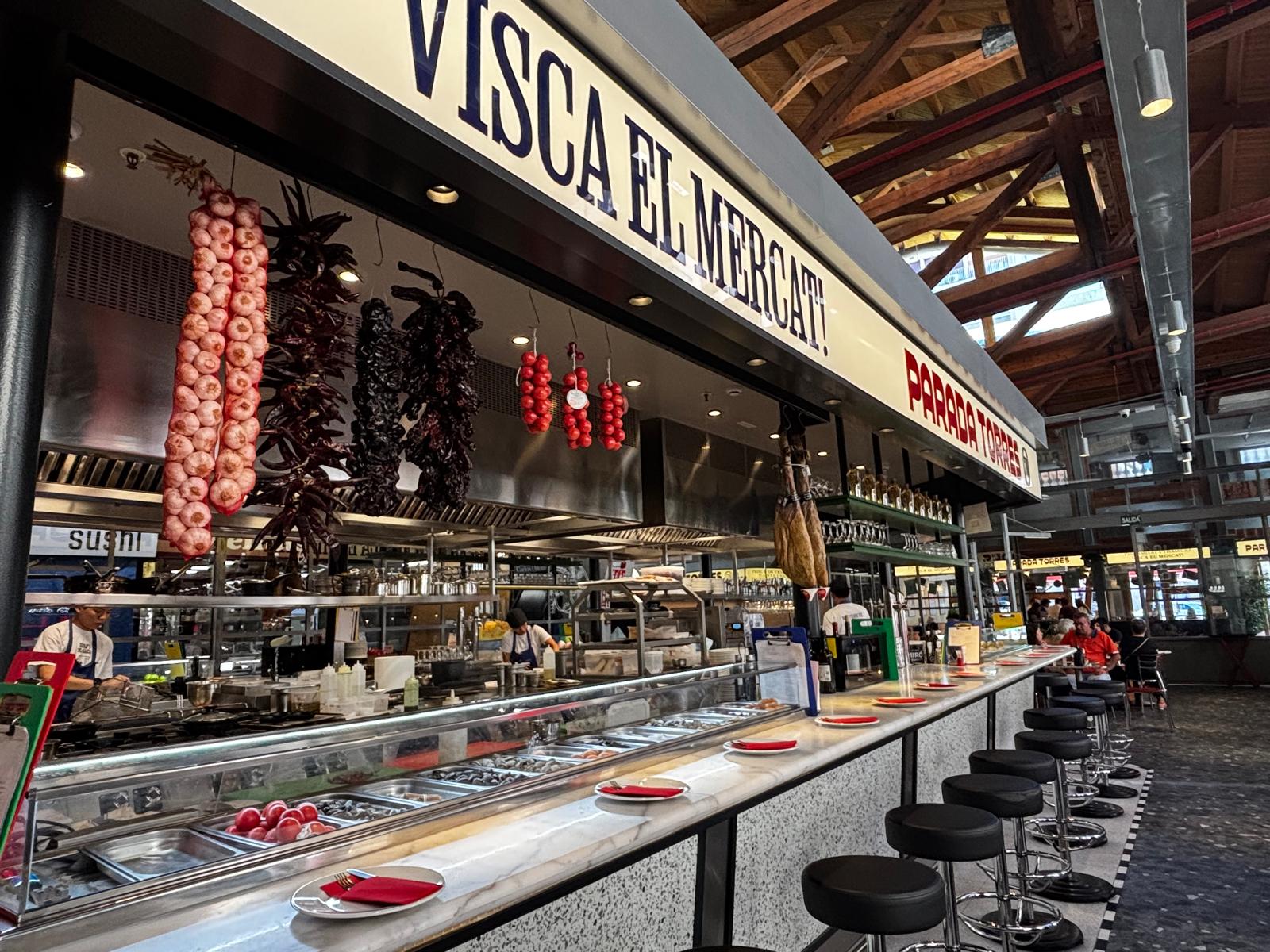
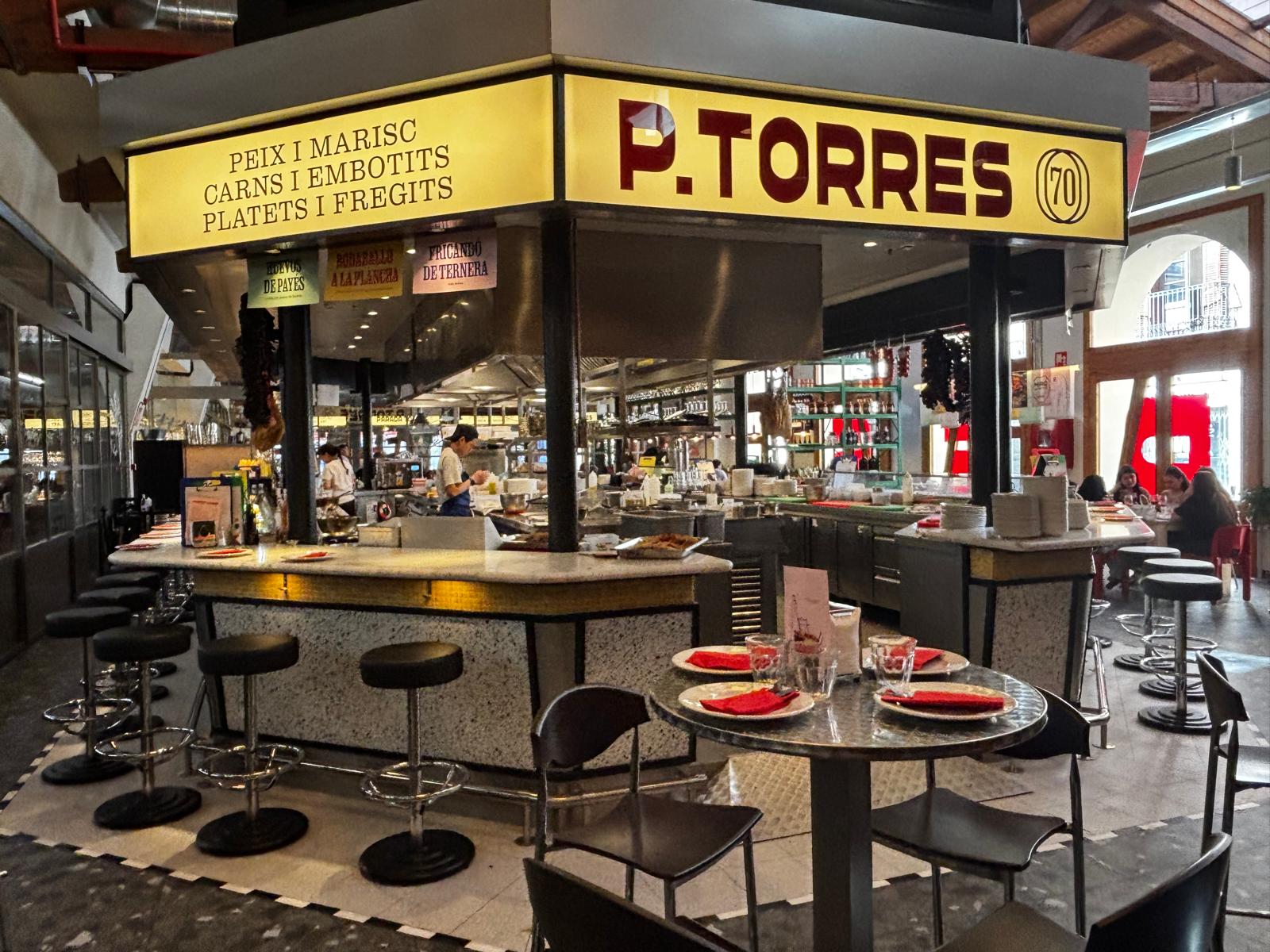
Then, in 2026, they returned to Mercat de Santa Caterina, the market where, as children, they used to shop with their grandmother Catalina, and opened a new place: Parada Torres. “Parada” means a market stall, a shop within the market. And that is perhaps the most charming part of the story: having reached three Michelin stars, they return to where it all began, the market of their childhood.
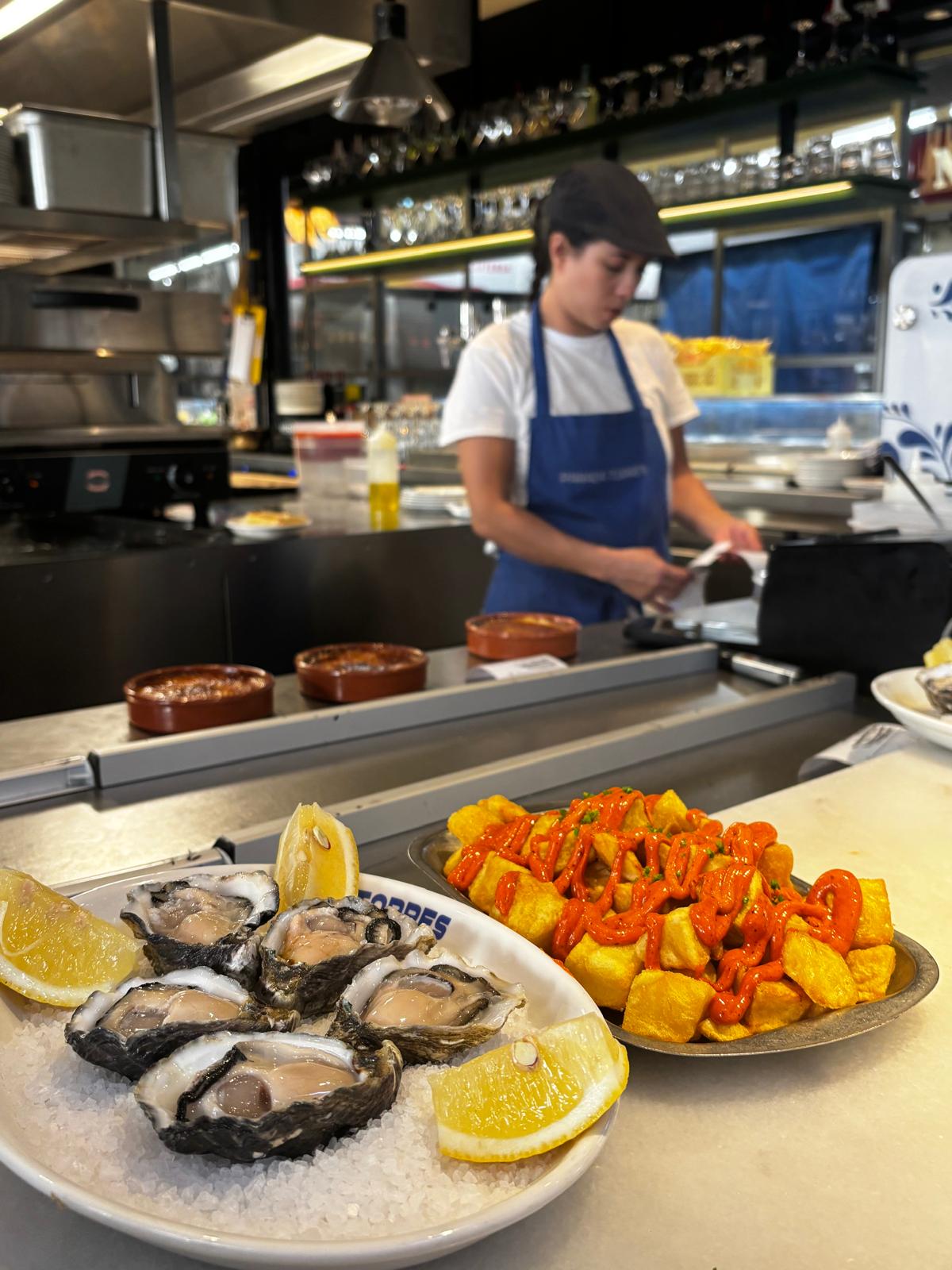
Except Parada Torres is hardly a modest little market stall. Spread across a sizeable area inside Mercat de Santa Caterina, it is a bar-restaurant with an open kitchen, a large counter, dining tables and a terrace, capable of serving well over a hundred people. Unlike the limited number of tables at the three-Michelin-starred Cocina Hermanos Torres, this is a busier, more relaxed and more accessible operation. The ambition here is obviously not to create gastronomic masterpieces, but to serve simpler, shareable dishes and tapas at more accessible prices.
Accessible, yes. Cheap, not quite. Share a few plates, and you will still struggle to leave for much less than €40–50 per person. And remember, part of that bill is for the Torres name. It is difficult to deny that many people who come to Parada Torres are, first and foremost, hoping to inhale a little of the Michelin stardust they imagine has settled on the plates.
I visited Parada Torres on a Sunday at lunchtime. Let me say this from the outset: overall, the food fell short of my expectations. Was it bad? Absolutely not. Some dishes were, in fact, very good. But taken as a whole, what I encountered was a restaurant whose equivalents could easily be found elsewhere in Barcelona’s tourist center.
Perhaps the problem was my own expectation. When you hear the Torres name and three Michelin stars in the same sentence, you inevitably expect something more: stardust.
The service, on the other hand, was — without trying to soften the language — a complete disaster. Of course, it was Sunday lunchtime, and the restaurant was busy. That may well have played a part. There were two of us, and we were seated directly in front of the bar, precisely where waiters placed orders and dishes emerged from the kitchen. So we did not observe the chaos of service from a distance; we were sitting right in the middle of it.
There were constant arguments between the floor manager, the waiters, and the cook behind the counter preparing and handing out the food. The tension travelled all the way to our table. Our waiter began taking our order and then suddenly disappeared. He became occupied with the floor manager, moved on to other customers, then eventually returned and resumed taking our order. Soon afterwards, some dishes began arriving twice.
That was how our meal began: in chaos.
There appeared to be five or six waiters working the floor, but behind the bar, or more accurately, in the part of the kitchen I could see, there were only two people working. Both were very young, one woman and one man. There was an obvious organizational problem and an equally obvious shortage of staff. Again, perhaps it was because it was Sunday. Perhaps we had arrived at an exceptionally busy hour. Perhaps it was simply a bad day. But in the end, you judge a restaurant not by how it is supposed to operate, but by how you actually experience it.
And before getting to the food, this was the central issue for me at Parada Torres: the distance between the expectations created by the Torres name and its three Michelin stars, and the reality I encountered.
While we were still studying the menu and deciding what to order, we immediately asked for two classics: Pan con tomate and a Gilda. Both belong to a small group of dishes I use as reference points. They may be among the simplest things you can order, but that is exactly the point. When something apparently simple is done properly, it becomes genuinely meaningful.
Here, the score was one apiece. The Gilda was exactly what a Gilda should be: worthy of its name, and good enough to be the kind you do not come across every day. The Pan con tomate, however, did not belong in a place like this. The coca bread may well have been good in itself, but what arrived in front of me was slightly cold and insufficiently toasted. I could taste neither the character of the tomato nor the salt on top. That depth of flavour I have found in countless far simpler places was, unfortunately, absent here.
Does Pan con tomate really deserve this much discussion? Yes, I think it does. Because it is a classic. It is a beginning. And sometimes the best way to understand a kitchen is to look at how it handles the simplest dish.
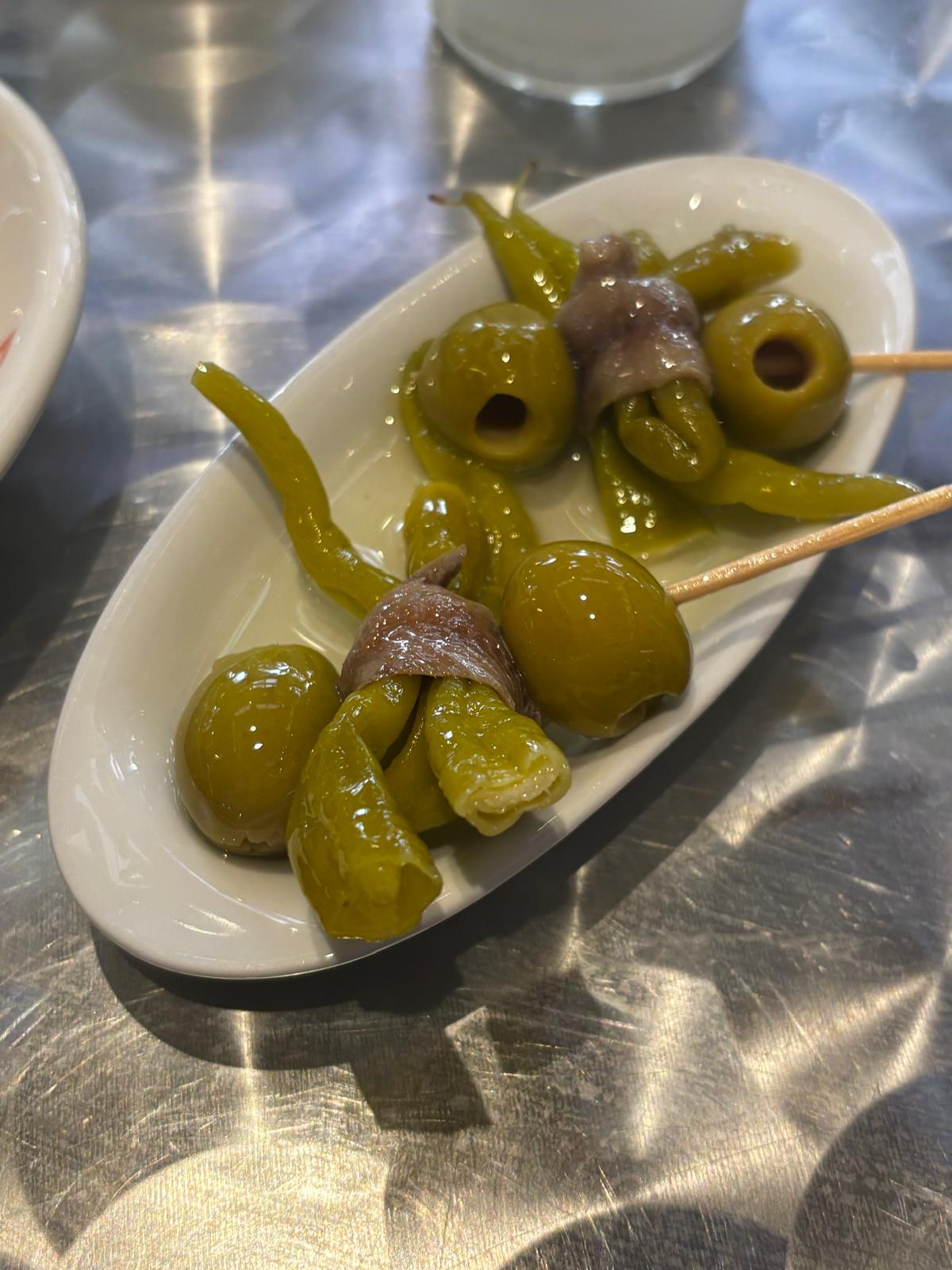
Gilda
Next came another of my reference dishes: Russian salad, Ensaladilla rusa. I have written about Russian salad many times. For me, it means a little bit of mother, a little bit of childhood and a little bit of New Year’s Eve. When I was a child, whatever else appeared on the New Year’s table, what I waited for was my mother’s Russian salad: mayonnaise, pickled cucumbers and little cubes of salami.
Of course, when the flavour you are searching for is your mother’s, it is not something you find very easily. But Parada Torres — the Torres Stall — became one of those rare places that satisfied that search. Russian salad is an extremely common and important tapa in Barcelona, and the version here was slightly creamier than most of its Barcelona counterparts. The pickles, the texture and the flavour all worked beautifully.
Would I come back here simply to eat the Russian salad? I might.
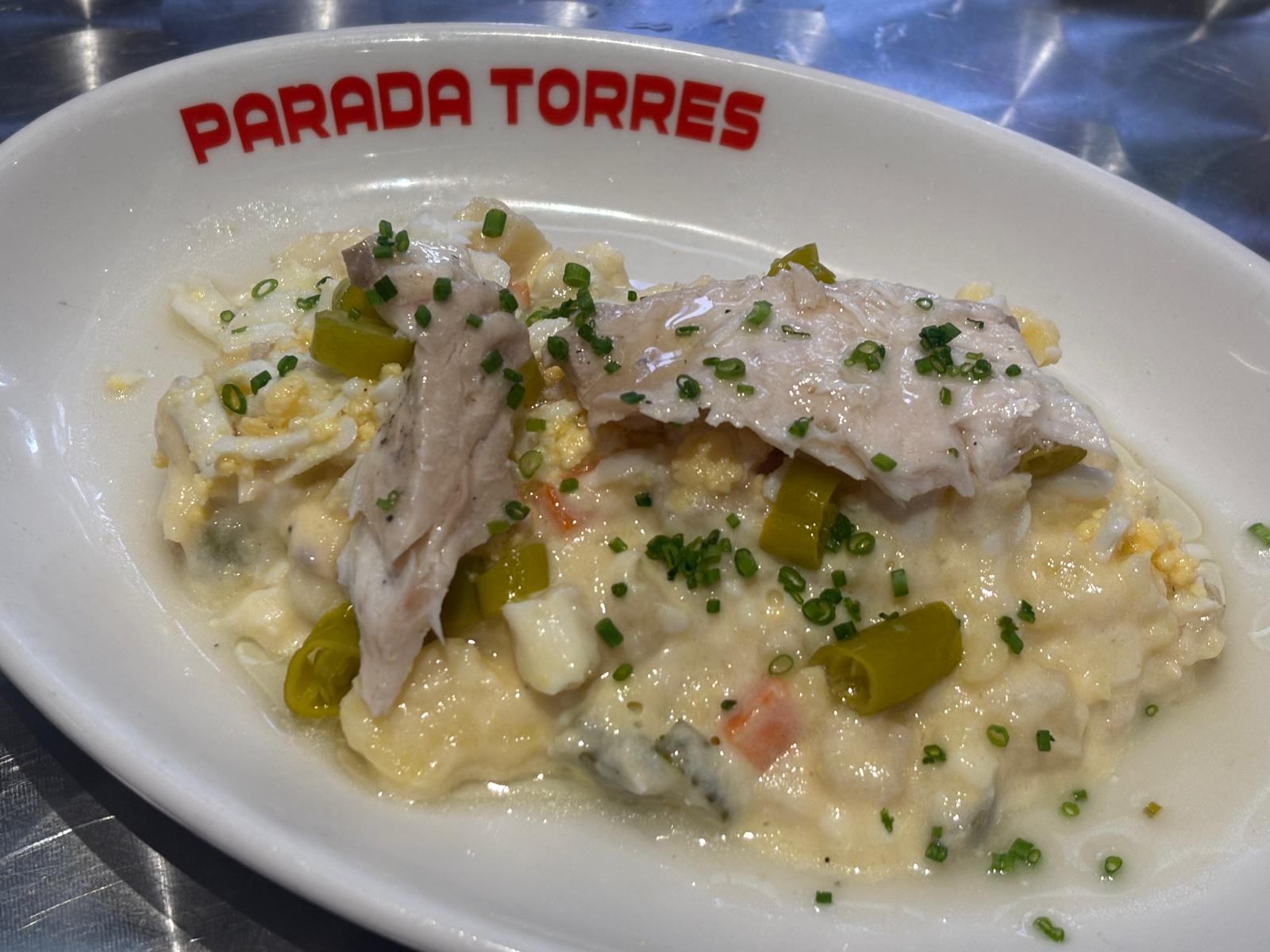
Ensaladilla rusa (Russian salad)
Then we moved on. One of the next dishes was another important reference point for me: Boquerones en vinagre, anchovies marinated in vinegar. And yet, if I am being precise, I barely tasted the fish. Or perhaps I simply could not.
Why? Not because the anchovies had lost all flavour, but because the tomato sauce and olive oil underneath them were so extraordinary that they overwhelmed the fish — and everything else on the plate. Magnificent. Can a tomato sauce and olive oil really have that much impact on a plate? This one did. It floored me.
Earlier I said Parada Torres was not setting out to produce gastronomic masterpieces. Well, if there was a masterpiece on this table, this was it. And there was no theatrical chef’s flourish involved, no contrivance wrapped in a clever story. No complicated techniques, no showy presentation, no list of fifteen ingredients. Tomato sauce, excellent olive oil and fish. That was all.
And yes, when simplicity itself becomes the achievement, it can be wonderful.
What was interesting was that the sauce beneath the anchovies looked remarkably similar to the one decorating the Esqueixada de bacalao. But I found nothing particularly memorable in the Esqueixada. Was it genuinely the same sauce? I do not know. Even if it was, it certainly did not produce the same effect. For me, this was the weakest dish on the table. In fact, it was the dish that pulled the entire meal down.
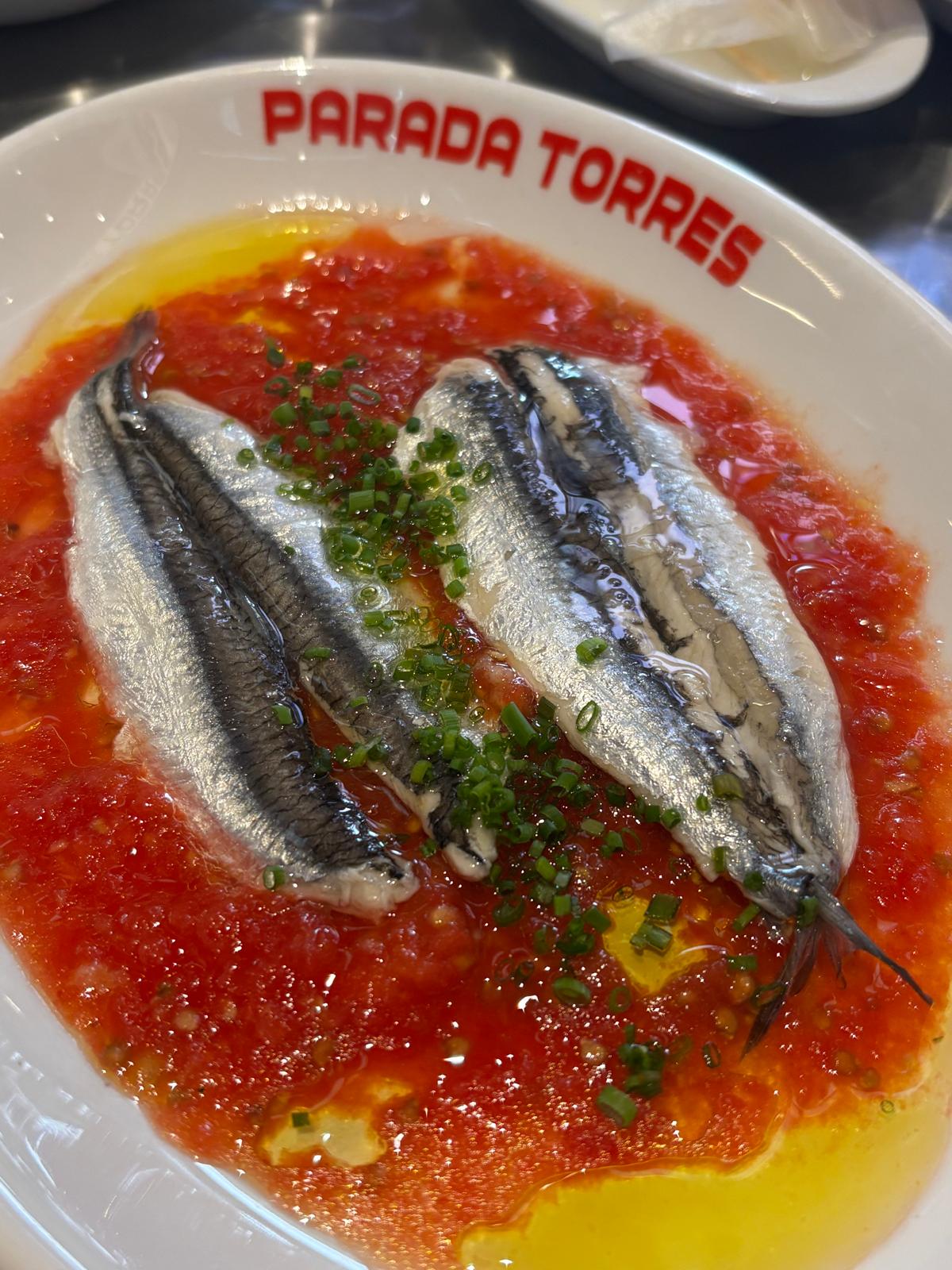
Boquerones en vinagre (Anchovies in vinegar)
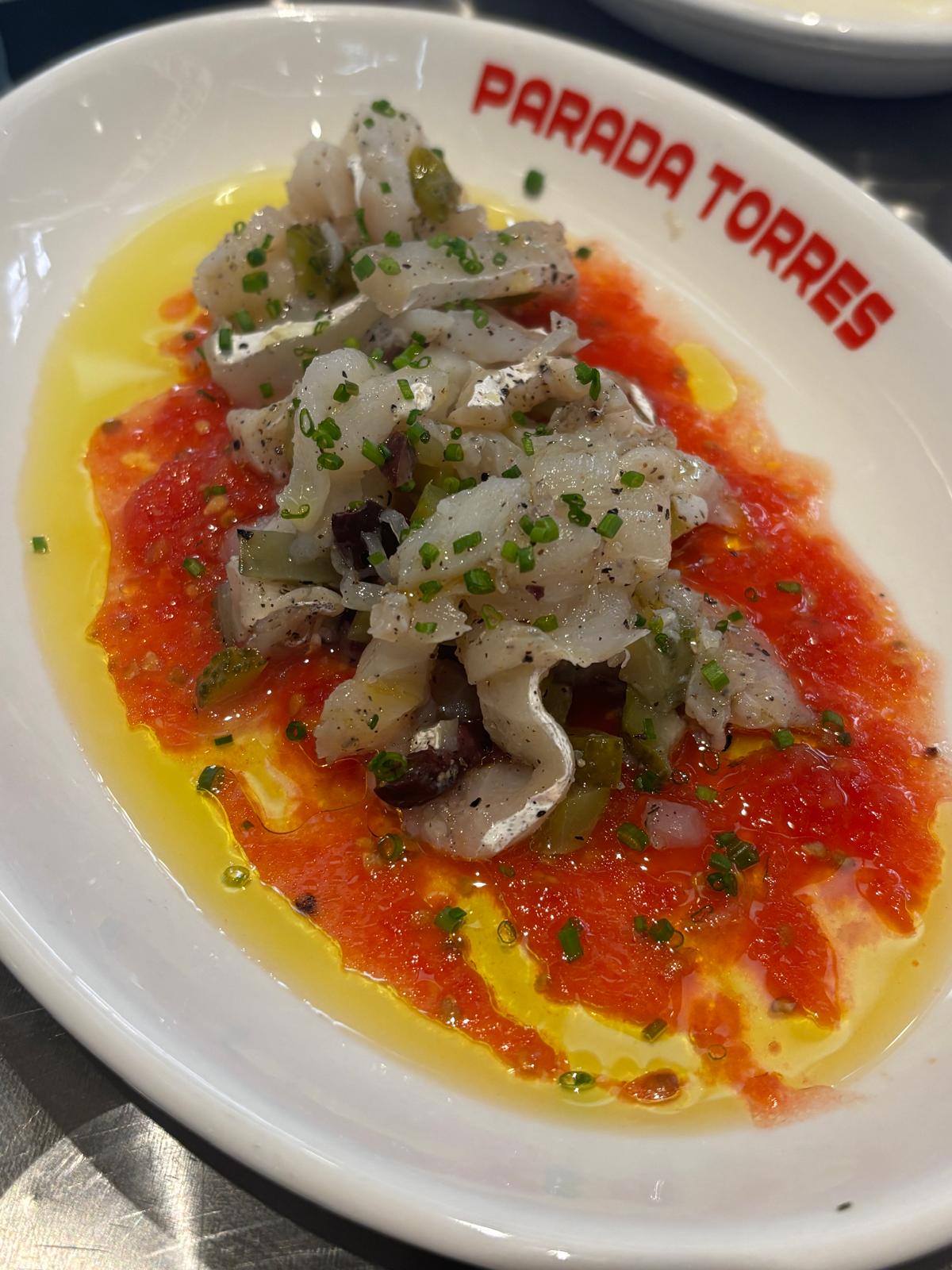
Esqueixada de bacalao (Catalan Salt Cod Salad)
The problem with the squid, meanwhile, was also its sauce. There was a beautiful, glossy green sauce on the plate. Parsley oil, I assume. It is very fashionable these days; chefs seem to pour it over plates as though it were some kind of culinary life raft.
But making something look good and making it taste good are not the same thing.
The intriguing part is that even chefs with three Michelin stars can apparently believe that anything touched by this bright green oil will automatically taste better. Or perhaps the people they trust believe the people they trust, who in turn believe someone else… and perhaps the people they trust believe it too. We could probably add another link to the chain, but it would change nothing: the parsley sauce added nothing to the squid.
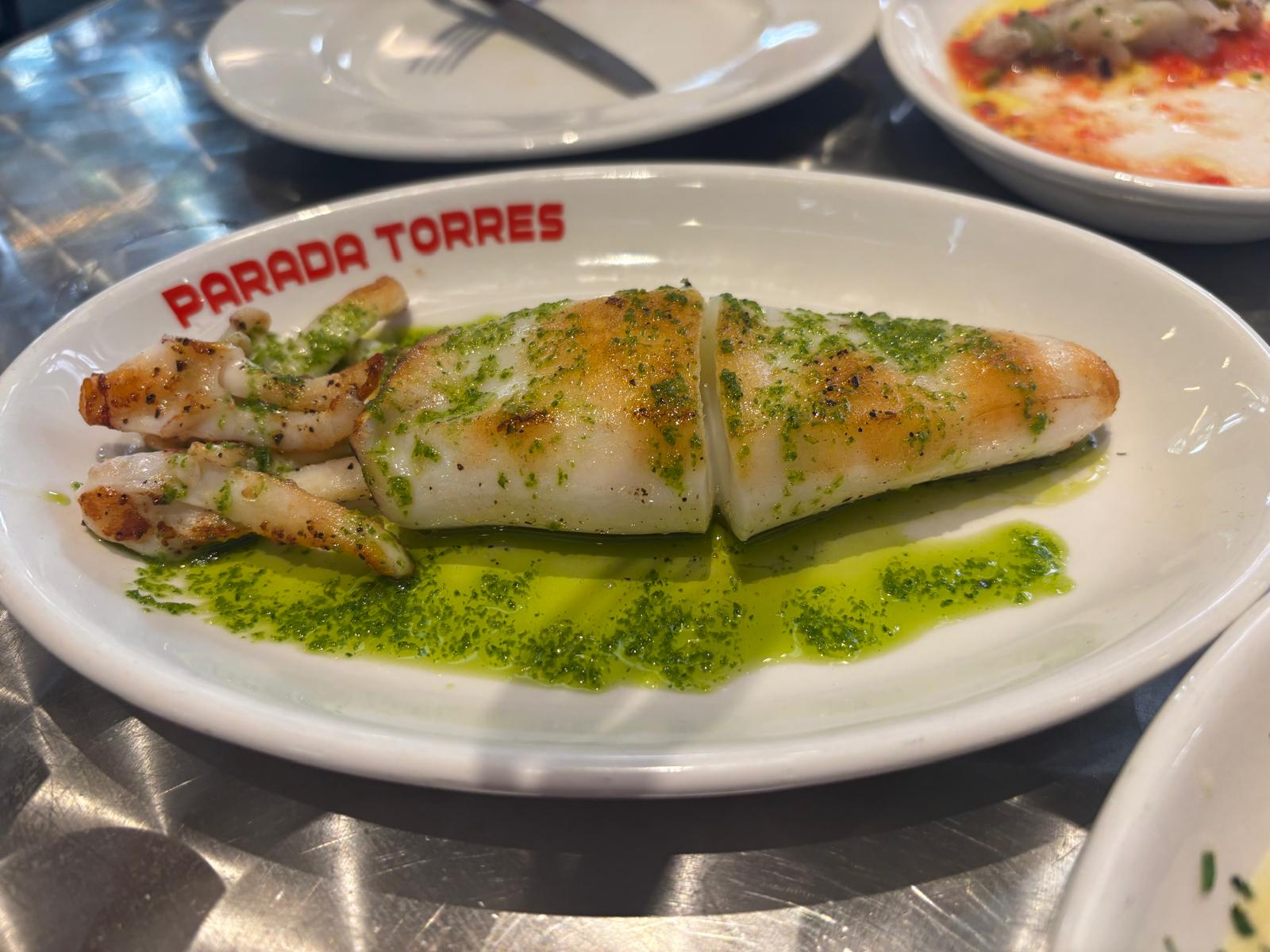
Squid
Our final dish was turbot served over roasted aubergine. The aubergine tasted neither roasted nor, frankly, particularly of aubergine. It really was little more than a bed. Synthetic. The fish had absorbed far too much oil.
There were perhaps fifty or sixty people eating between the terrace and the dining room, while two cooks were struggling away in the kitchen. How could they possibly keep up? The beautiful turbot had been ruined, in short. And that was a shame, not least because of all the effort those two young cooks were visibly putting in.
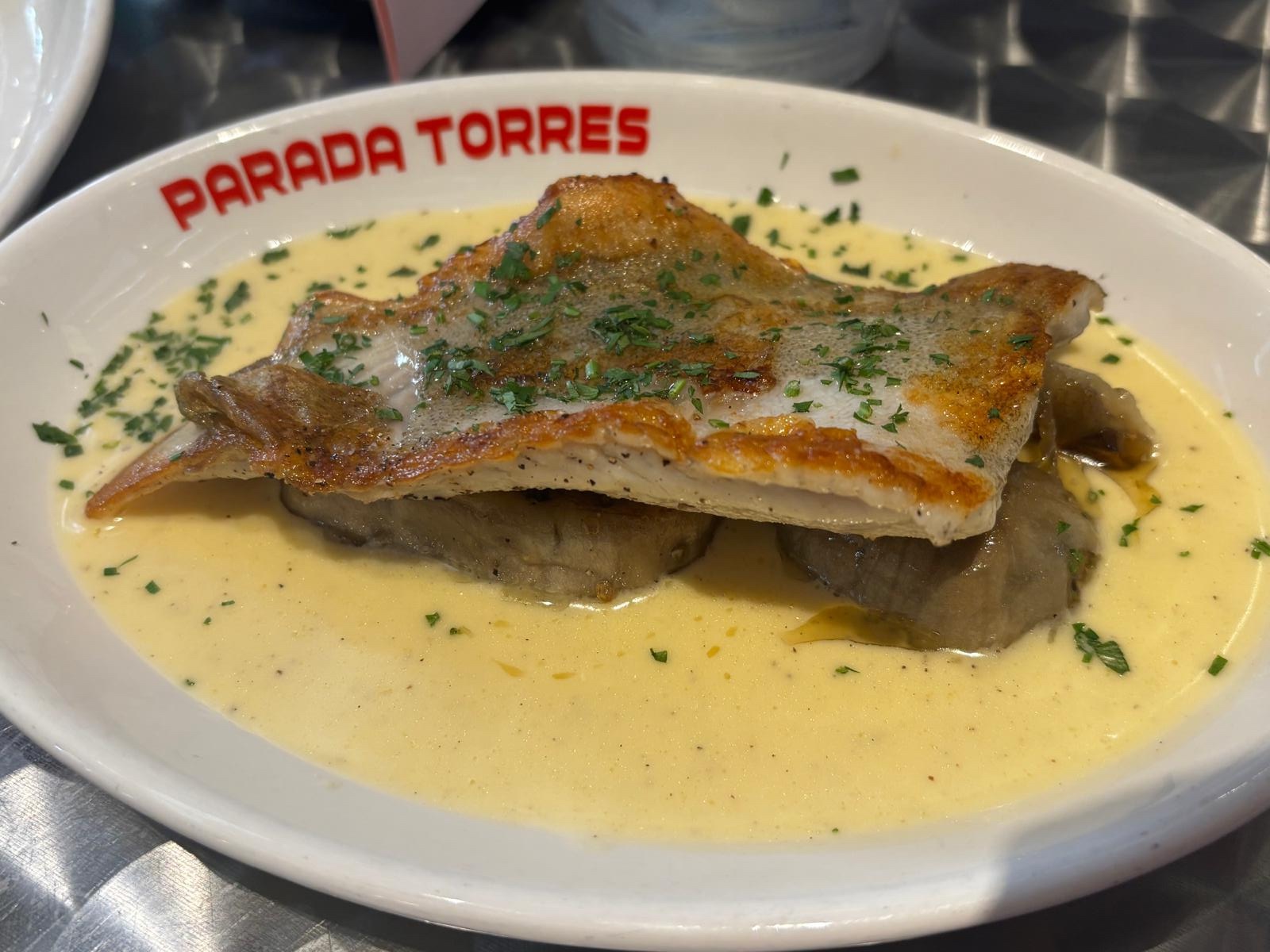
Turbot served over roasted aubergine
Perhaps the contradiction between all these plates is what best defines Parada Torres. On one side, a Russian salad good enough to bring me back just for that dish; and the tomato and olive oil beneath the anchovies, whose very simplicity came close to becoming a gastronomic masterpiece. On the other, an Esqueixada that had nothing to say, a squid dish that placed far too much faith in its sauce, and a beautiful turbot lost in oil.
Yet when all was said and done, what stayed with me more than the food was what seemed to have been sacrificed in the pursuit of making more money. I will not forget the chaos of the service, the tension in the way people communicated with one another, or the burden I saw being carried by those two young cooks in front of the kitchen.
Several times earlier in this article, I tried to soften what I saw by reminding myself that it was Sunday. Perhaps that really was the explanation. But when you watch two young people in the visible part of a kitchen trying to keep pace with an operation capable of serving well over a hundred guests, another question inevitably arises:
Why are these people being asked to carry so much?
Because when you try to lower costs by reducing staff and loading more work onto the people who remain, there are two consequences. The first is visible to the customer: service breaks down, orders are confused, dishes are delayed. The second remains behind the kitchen doors: people are crushed under the weight.
Which perhaps brings us back to the question with which this article began.
Is fine dining dead?
Perhaps death is not really the issue. Perhaps the economics of fine dining simply no longer work as easily as they once did. We are seeing a movement away from three-star dining rooms towards concepts that are larger, more casual, more accessible and capable of turning over far greater numbers of customers. There is nothing inherently wrong with that.
Moving from three Michelin stars to a market stall is, in itself, an interesting — even valuable — idea. You can leave technique, spectacle and protocol upstairs.
You cannot leave flavour behind.
And there is one other thing you cannot leave behind:
respect for people.
If the route out of fine dining — the route towards serving more people, turning more tables and making more money — depends on placing an ever greater burden on the people doing the work, then a different problem begins. I cannot say, on the basis of a single visit, that this is definitively what is happening at Parada Torres. But what I saw made me ask the question.
And if that is the answer, I do not accept it.
Parada Torres
Mercat de Santa Caterina, Av. de Francesc Cambó, 16 Ciutat Vella, 08003 Barcelona
