


Nazende: Chef or Cook?
I first heard about Nazende through Vedat Milor’s writing. Knowing how highly he regarded it, I did not wait long before going myself. Since that first visit, I have been back four or five times. Most recently, I had the chance to return at the end of this summer.
Every time I eat at Nazende, the same question comes to mind: Is what happens here cheffing, or is it cooking?
I am not asking because I place the chef above the cook. If anything, when it comes to Nazende, I think the opposite. The value of what Uluç Sakarya does lies less in what contemporary gastronomy tends to celebrate as “cheffing”—creativity, signature dishes, unexpected combinations, the urge to reinterpret something familiar—and much more in very good cooking.
Vedat Milor, writing about Nazende, repeatedly emphasises two things: good ingredients and seasonality. I would add a third, and perhaps the most important: knowing how to cook.
Easy to say. Much harder to do.
Because much of what arrives at the table at Nazende is already familiar. You know Mücver (courgette fritters). You know Beyin Söğüş (cold dressed lamb’s brain). You know Kokoreç (char-grilled seasoned lamb intestines). You know Kelle (lamb’s head). Nor is there any attempt to intervene until these dishes become unrecognisable. Kelle remains kelle; kokoreç remains kokoreç. But with the right ingredient, the right fire and the right cooking time, you are reminded just how good something you thought you knew can actually be.
This, I think, is where Uluç Sakarya’s real talent lies.
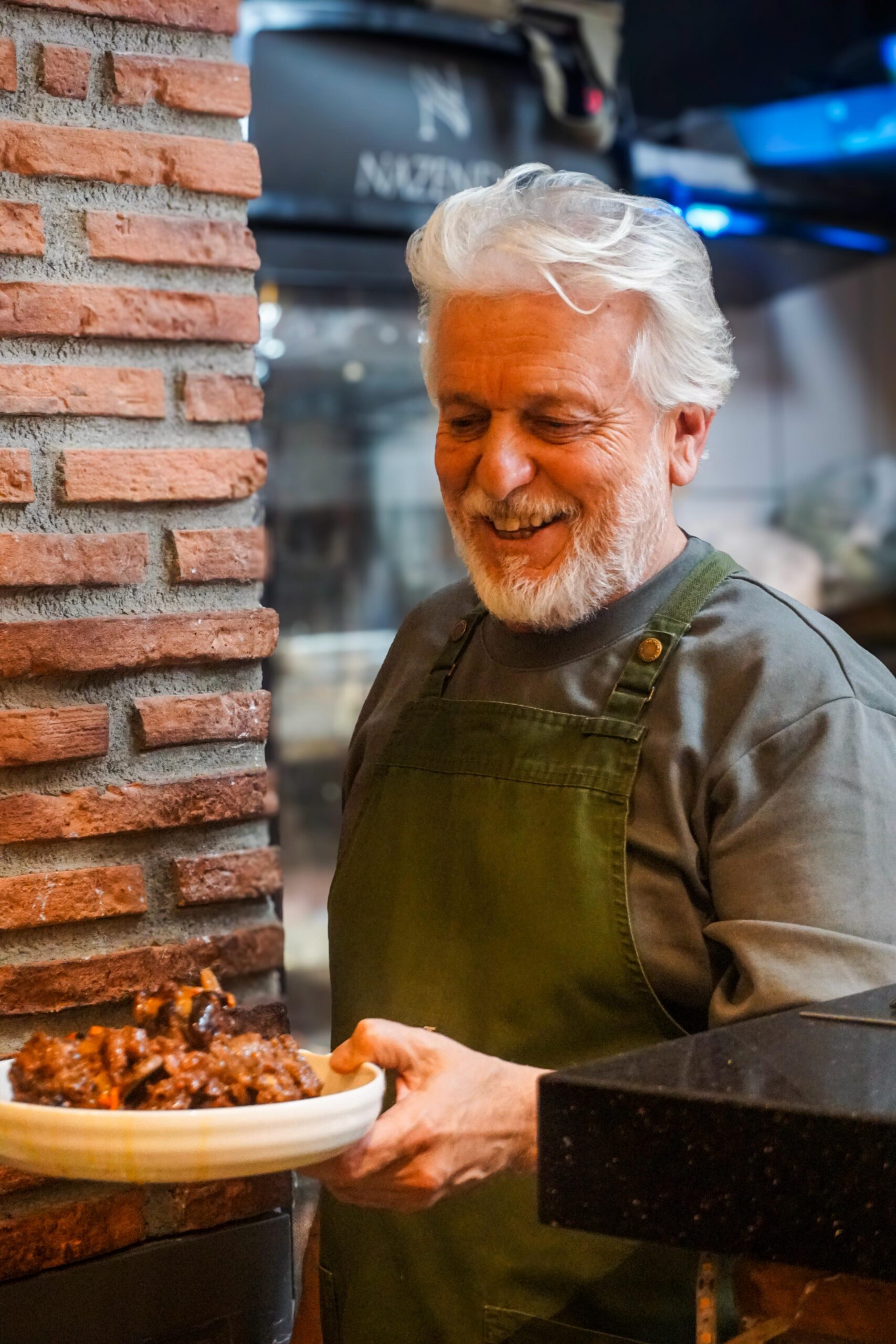
Uluç Sakarya
He understands the oven and fire exceptionally well. You notice it particularly with meat. Kelle Tandır (slow-roasted lamb’s head) is one of the clearest examples. The one we ate on our latest visit was extraordinary, among the best I have ever had. I could have done without the dill scattered over it; apart from adding colour, I am not convinced it contributed much to the dish. I had forgotten to warn them beforehand, and dill and I have never been particularly good friends anyway.
The Beyin Söğüş I remember from earlier visits was similarly excellent. A chef does not necessarily need to take a lamb’s head or a brain and transform it into something else. Sometimes the point is simply to turn it into the best possible Kelle, the best possible Beyin Söğüş.
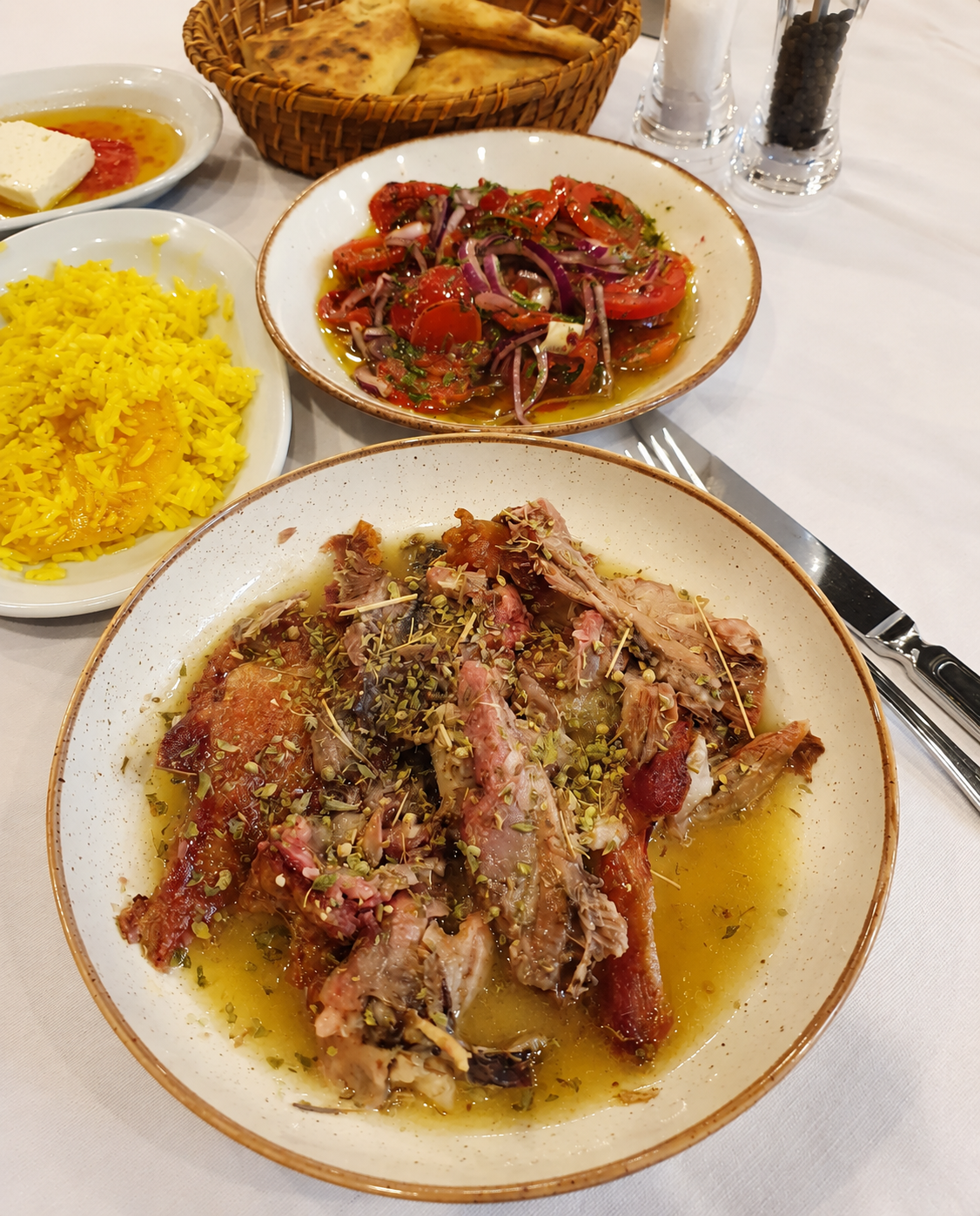
Kelle Tandır (Slow-Roasted Lamb’s Head)
And it is impossible to talk about Nazende without giving Oğlak (young goat) a place of its own. To my mind, oğlak is Nazende’s true signature ingredient. I also think the various goat dishes played an important role in establishing the restaurant’s reputation during its early years. Different cuts, particularly Oğlak Tandır (slow-roasted young goat) and Oğlak Gerdan (young goat neck), show Sakarya’s understanding of ingredient and fire at its best.
The Oğlak Gerdan on our latest visit was superb. Tender without surrendering its texture, with its fat and gelatin turned entirely into flavour. Still, encountering young goat at the end of August inevitably raises a question about seasonality. For a kitchen so closely associated with season and produce, perhaps this is a small contradiction worth noting.
The same philosophy reveals itself in the Mücver. This is an utterly familiar dish, belonging as much to the home as to the traditional lokanta. Everyone at our table of five loved it almost immediately because everything that needed to be done had been done. Nothing more.
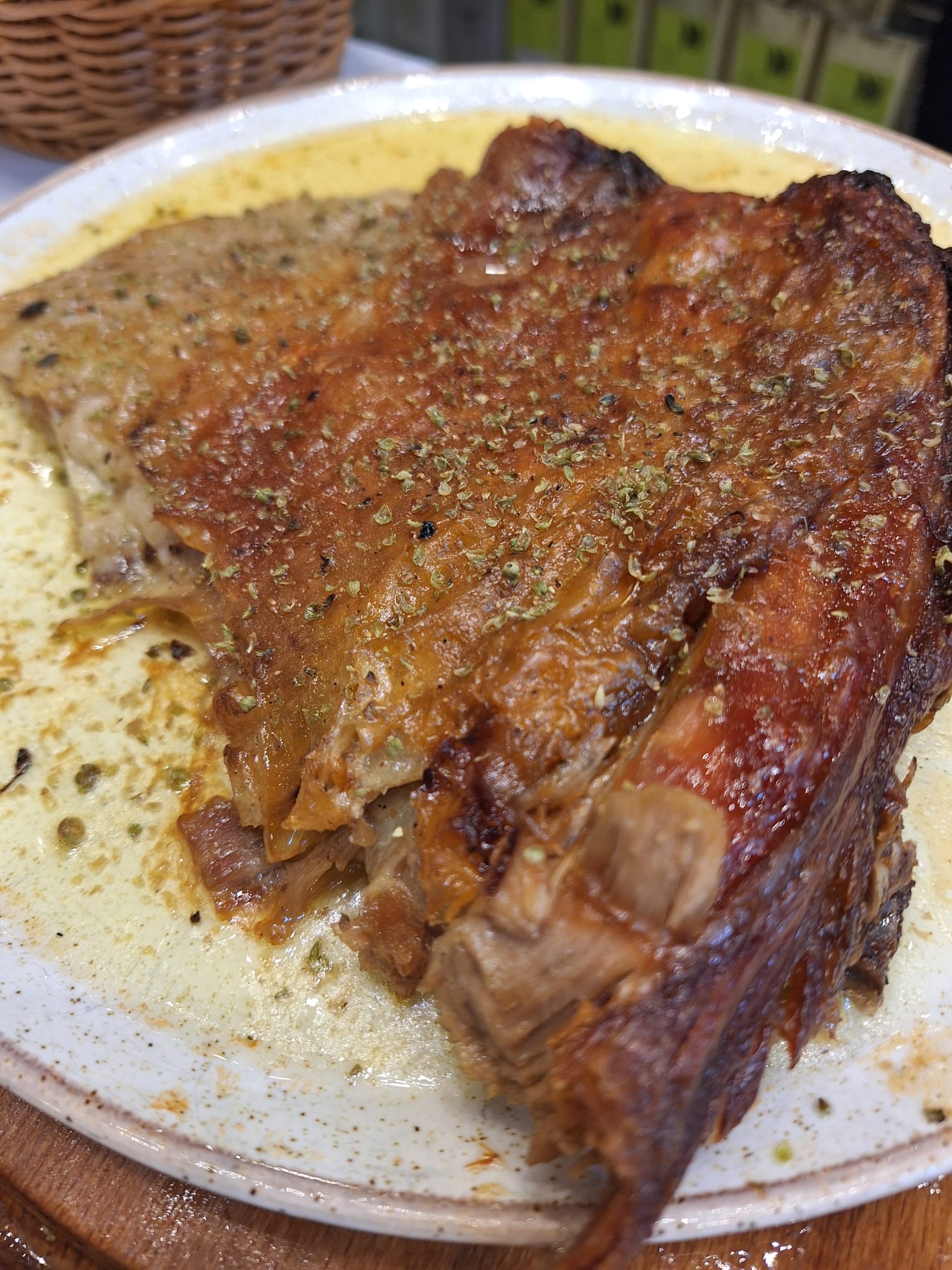
Oğlak Tandır (slow-roasted young goat)
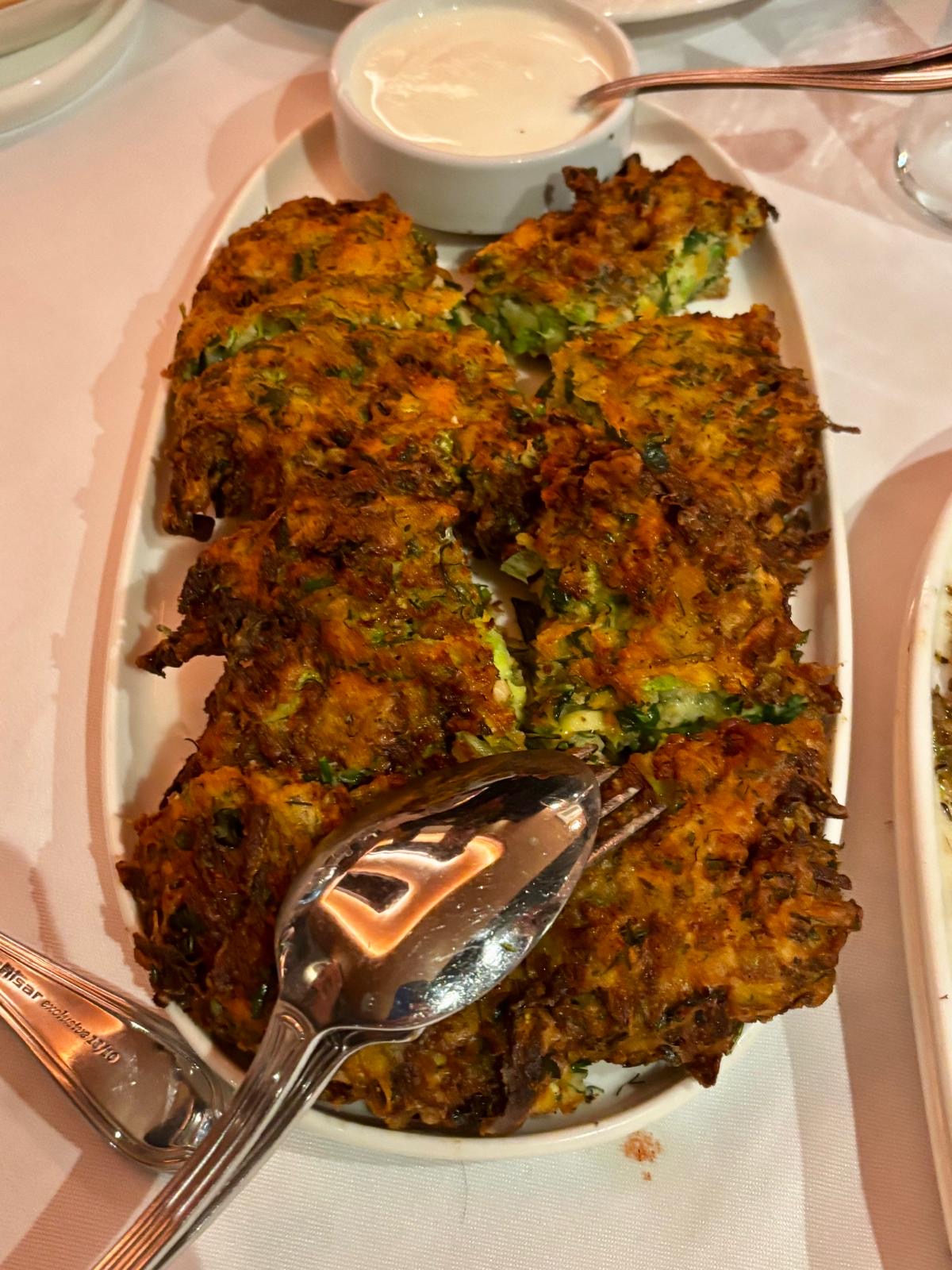
Mücver (Courgette fritters)
The Kabak Tempura (courgette tempura) offers a different example. The idea is not so remote from Istanbul and Aegean traditions of courgettes and frying, though the technique comes from elsewhere. At Nazende, the cooking was flawless: an exceptionally thin, dry, crisp coating, absorbing no excess oil and never suffocating the courgette underneath. Yet this time, the technical accomplishment was not matched by flavour. The technique was a ten; the dish was not. An important distinction, because good cooking cannot be reduced to technical perfection alone.
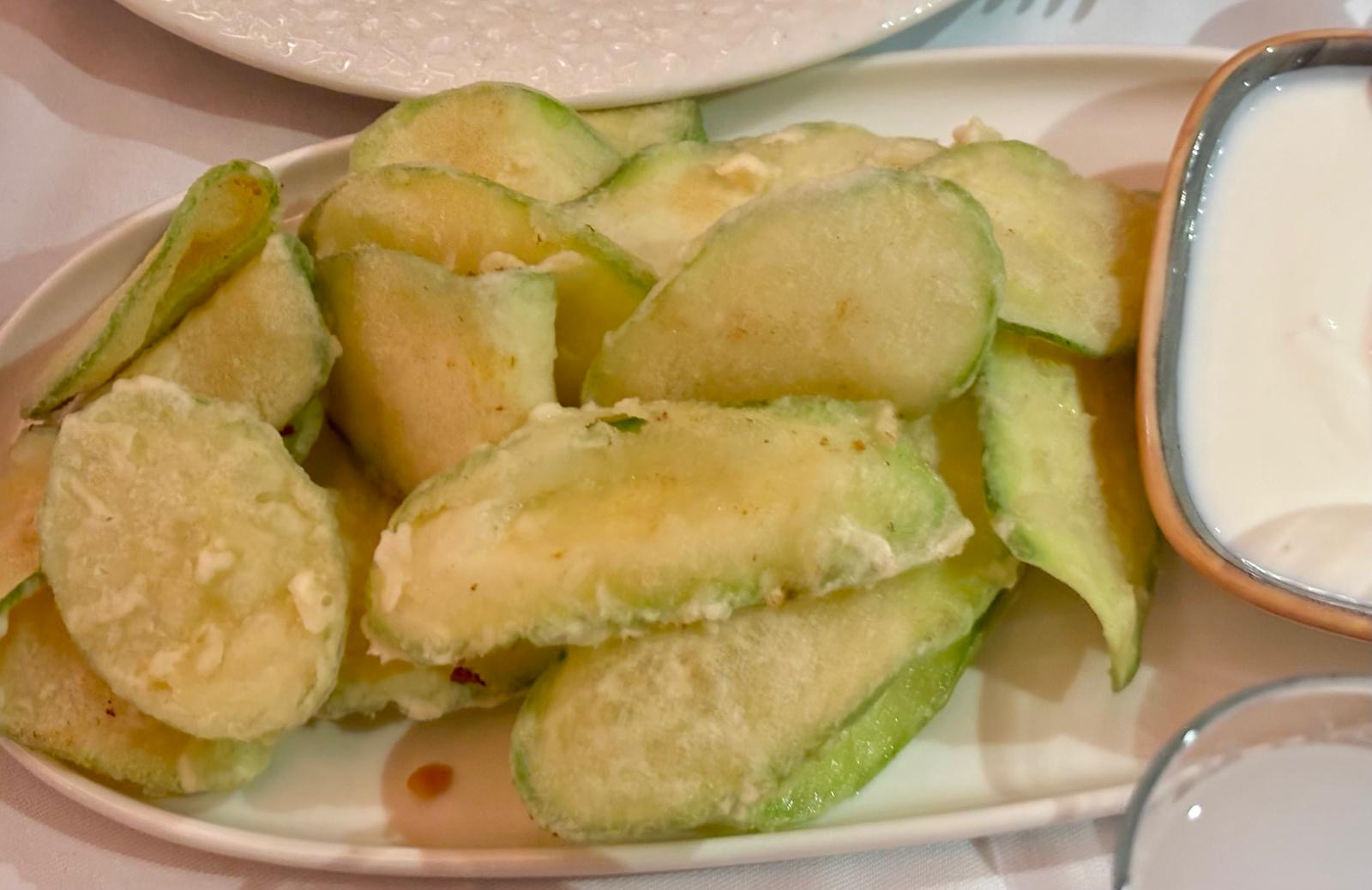
Kabak Tempura (courgette tempura)
Another thing I like about Uluç Sakarya is his curiosity. He is not a cook enclosed within his own cuisine. Yet that curiosity usually begins with the ingredient. When he finds good calamari, he cooks calamari. When he finds good prawns, he cooks prawns. At a time when finding a genuinely good doner kebab in Istanbul has become surprisingly difficult, he makes a lamb doner kebab—and makes a very good one.
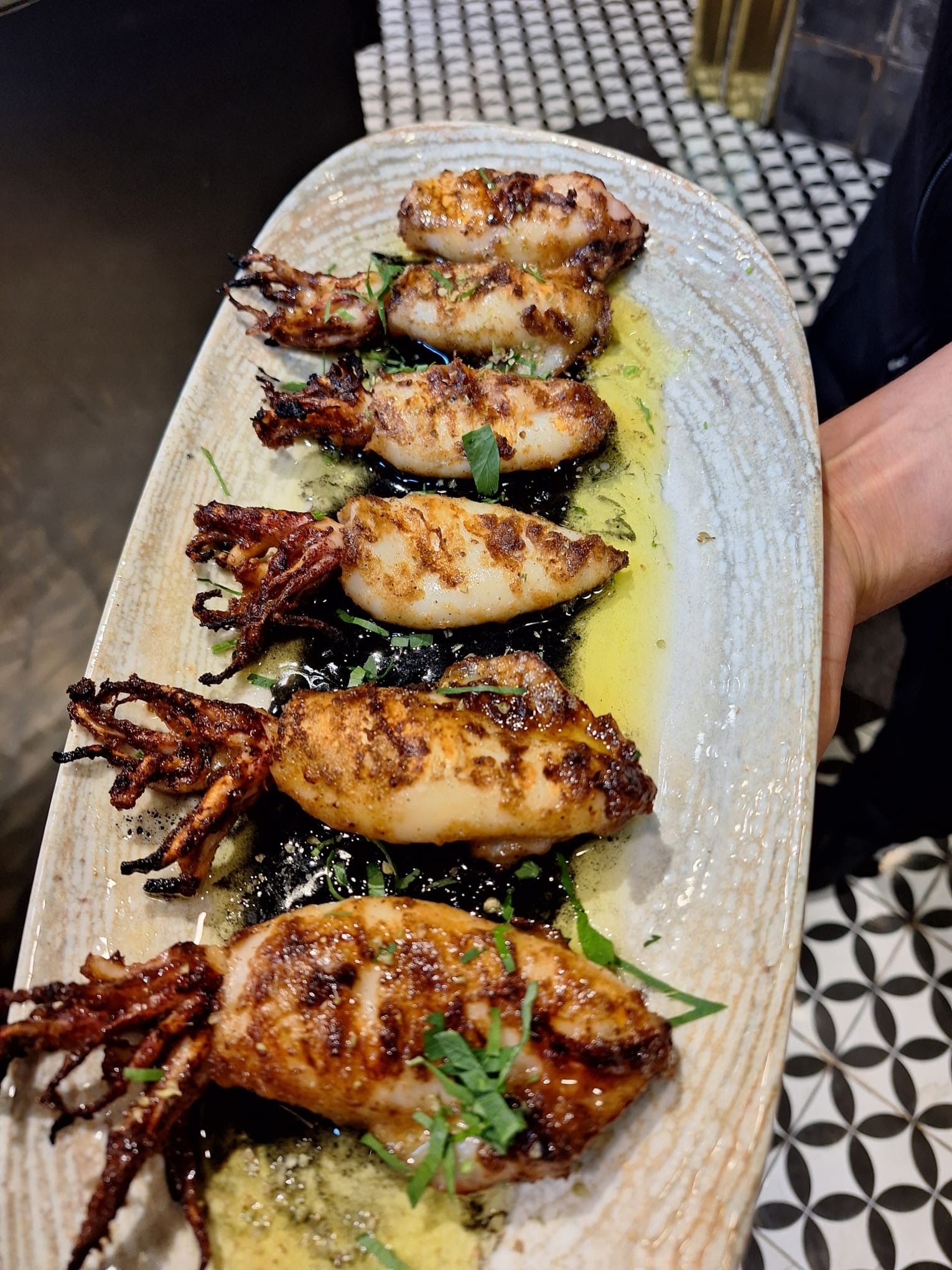
Calamari
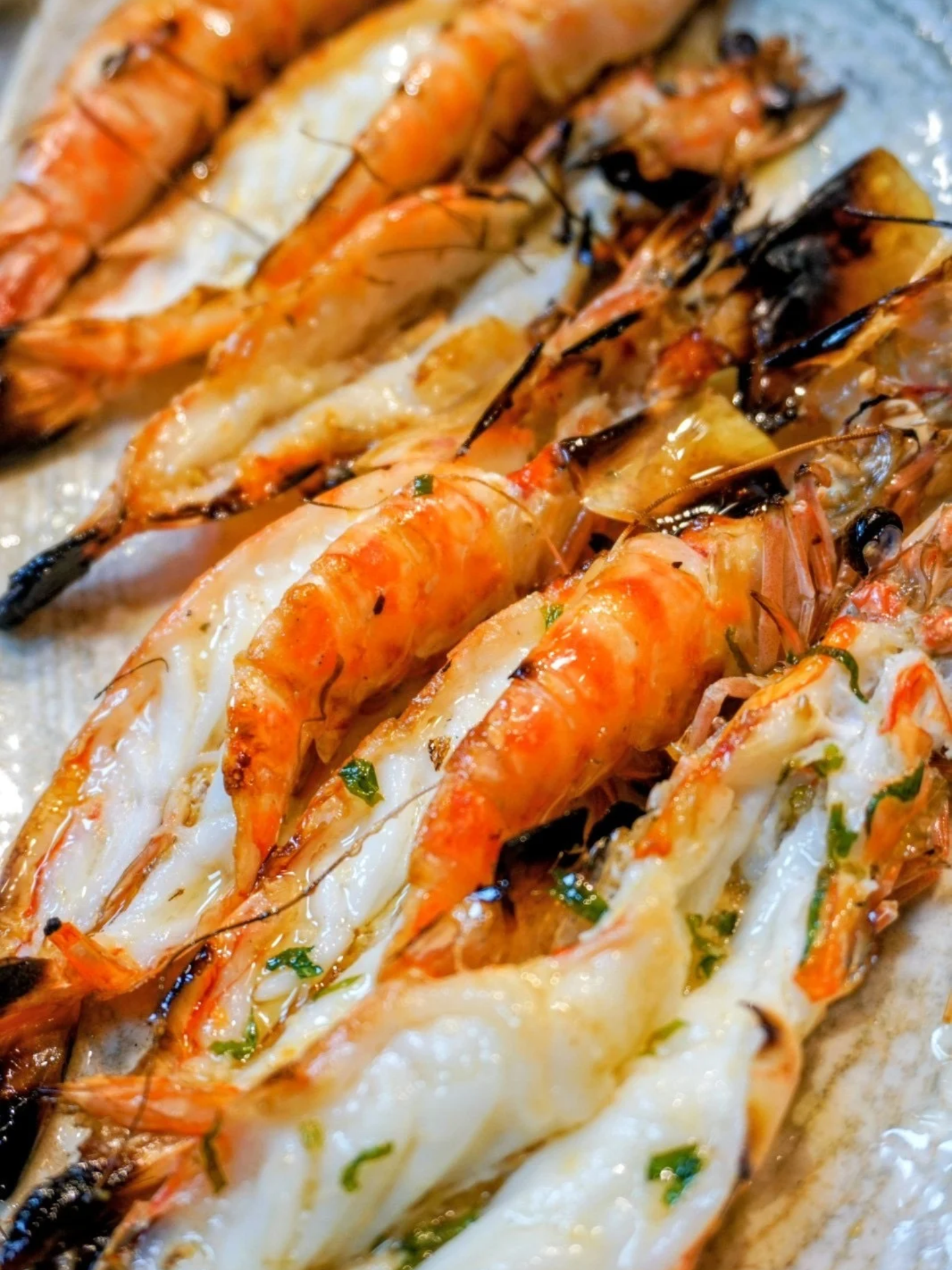
Prawns
And then, of course, there is the oven. Where there is an oven, can Lahmacun (thin flatbread topped with seasoned minced meat) and Pide really be far behind?
Nazende is neither a kebab restaurant, nor a lahmacun shop, nor a pide salon. But when Uluç Sakarya decides to make one of them, he does not make it casually. He works at it: the ingredients, the dough, the fire, the cooking. He tries to make the best version he can. The result is that his lahmacun and pide can be better than those served by places supposedly specialising in them. In a way, this sums up the entire Nazende story: if he is going to make something, he wants to make it properly.
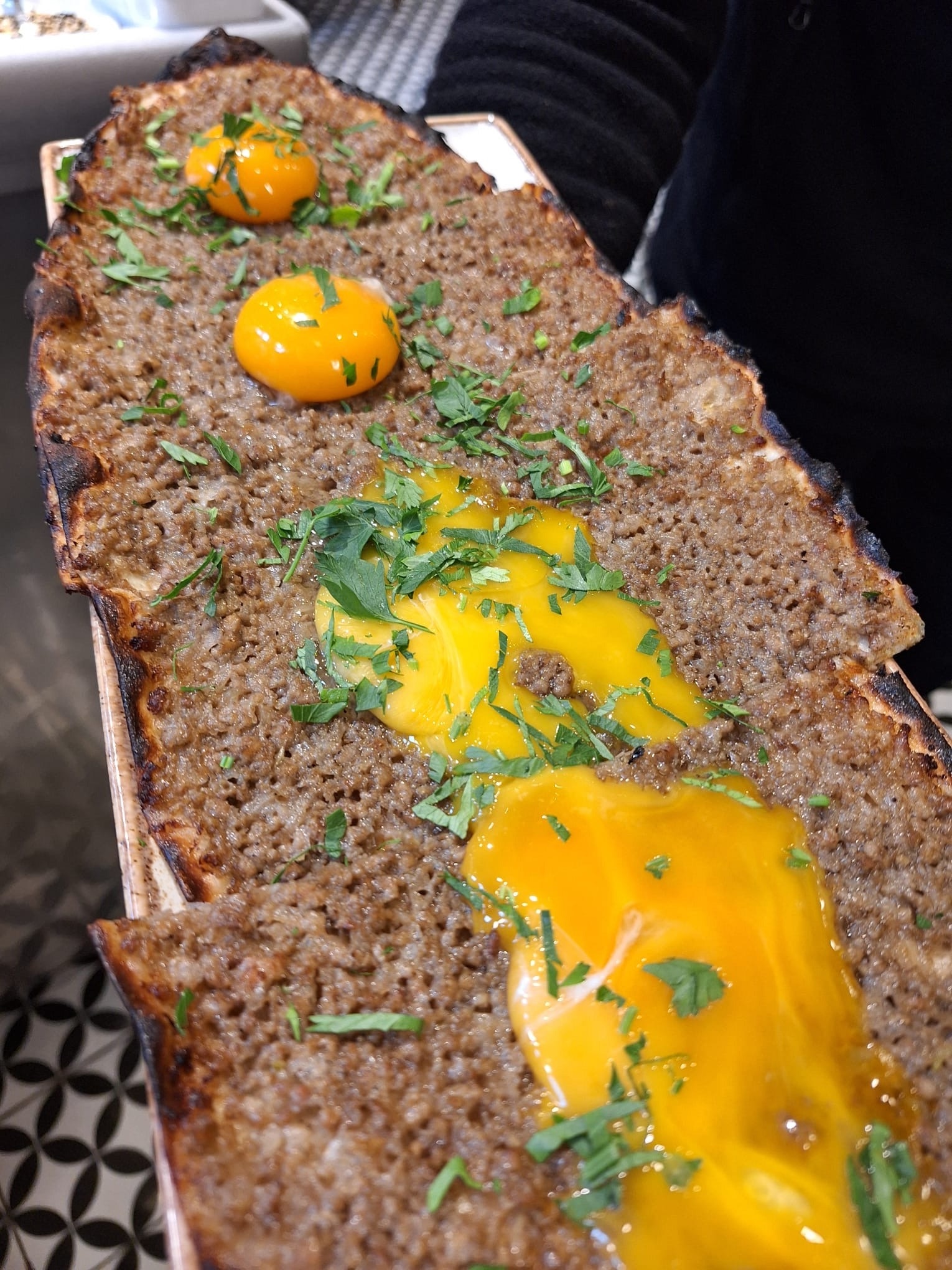
Pide
And suddenly a plate of Padrón peppers may arrive at the table. Having eaten more than my share of Padrón peppers over the years in Spain, I can comfortably say that the ones we had at Nazende on this visit would hold their own among the best. Sakarya looks outward, tastes, learns, and, for the most part, understands what can meaningfully be brought back into his own kitchen.
For the most part.
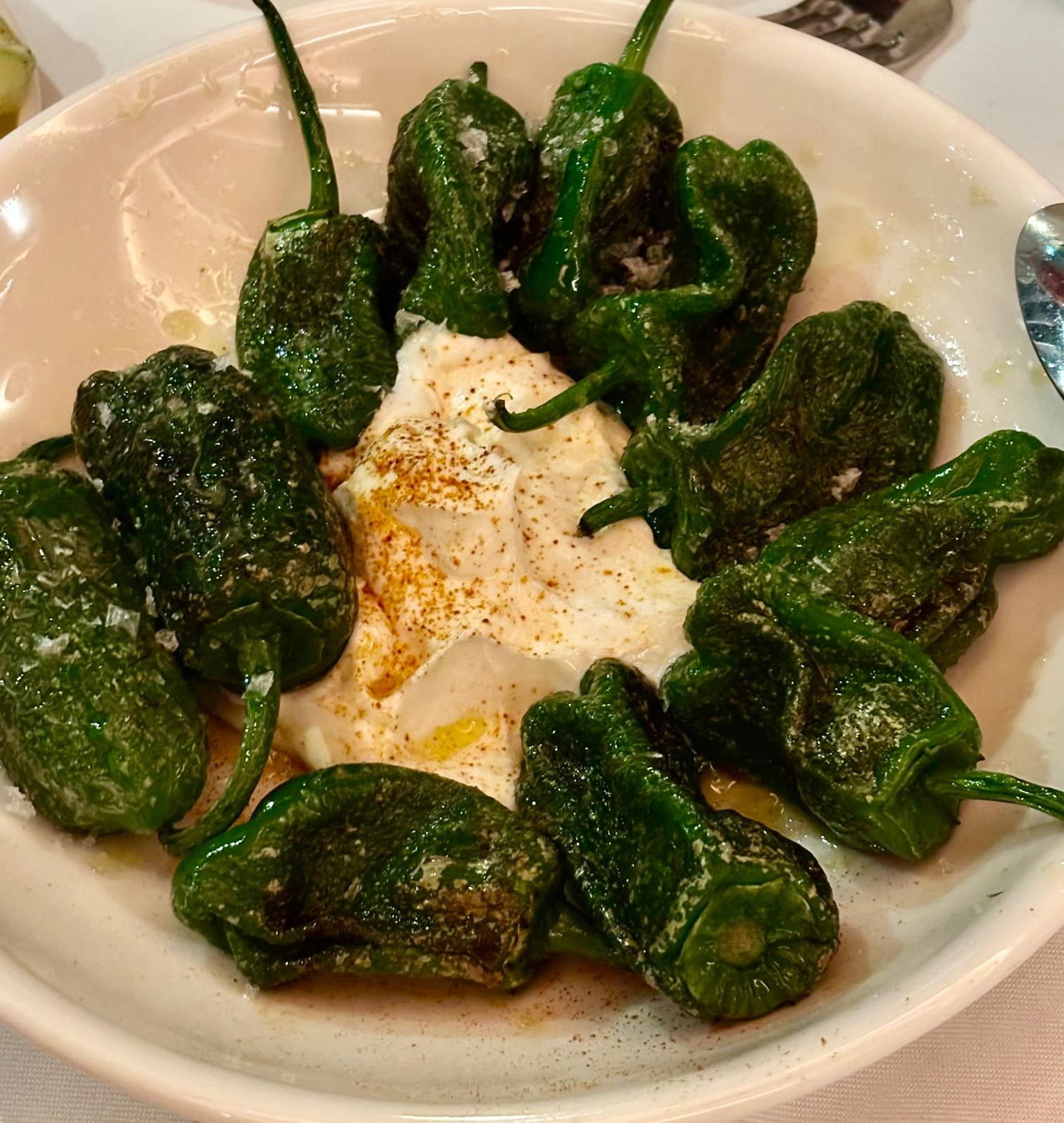
Padrón Peppers
Because the Sicilya Usulü Kontrfile (Sicilian-style sirloin) we had this time struck me as precisely the sort of territory Uluç Sakarya need not enter. The meat had dried out and was being rescued by its sauce; the result barely rose above the level of an average home-cooked dish. More importantly, it simply did not feel like Nazende.
But even this failure tells us something about the restaurant. There was no “chef’s trick” here either. This time, the cooking simply did not work.
Perhaps this is precisely where we should look for the reason Nazende is so good: Uluç Sakarya generally knows what he knows, knows what he does well, and knows where to stop. He uses creativity not to dismantle a dish he understands, but to make it better.
And sometimes the most creative act in gastronomy is not inventing something new. It is making something everybody knows better than almost anybody else can.
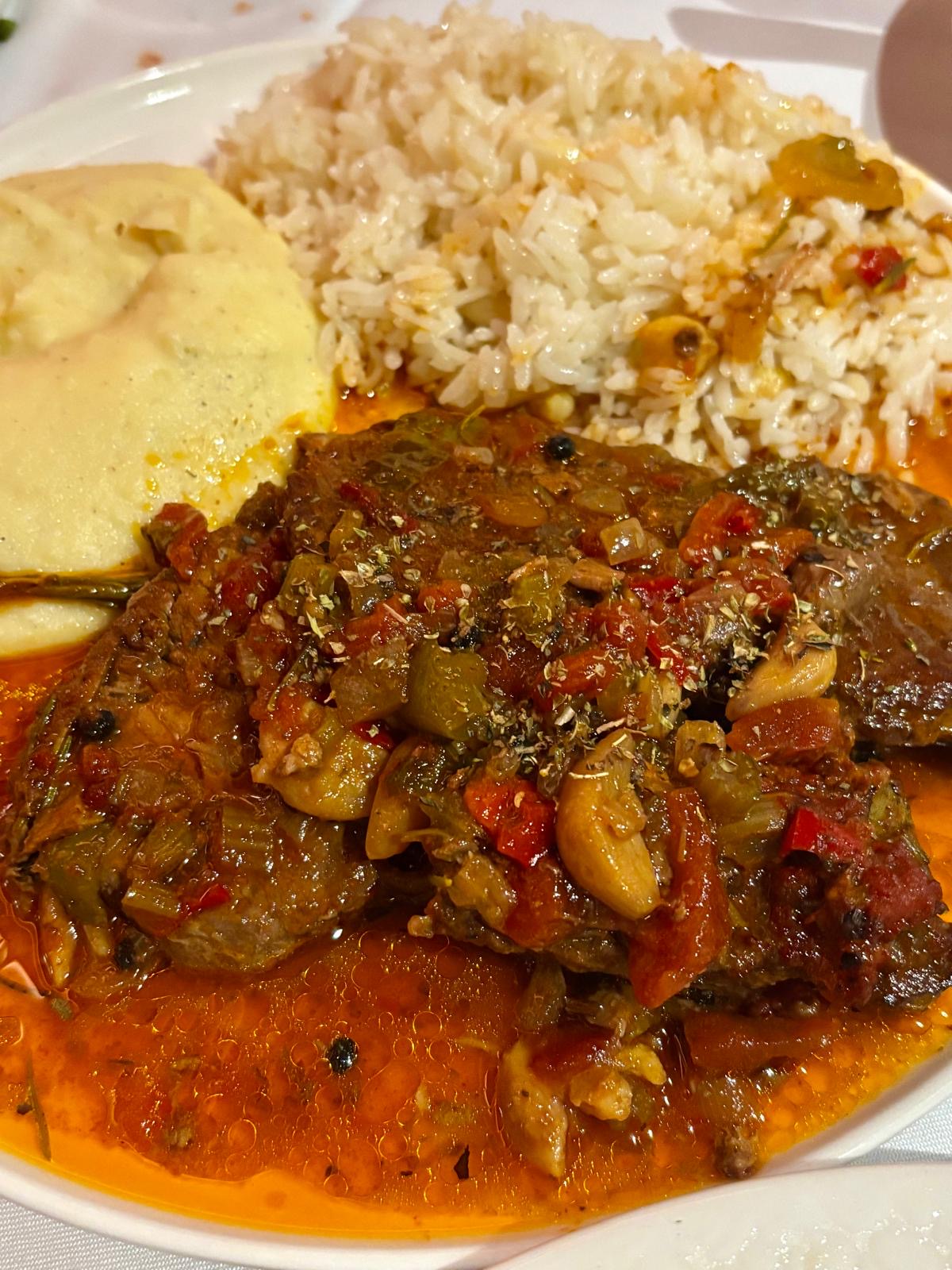
Sicilya Usulü Kontrfile (Sicilian-style sirloin)
Then there is the question of price.
There was a period when Nazende’s prices genuinely bothered me. It was not like that in the beginning. Then, at some point in the middle years, the prices climbed to levels I found astronomical. Today, curiously enough, I find it much harder to make the same complaint.
Not because Nazende has become cheaper. Istanbul has become so expensive that Nazende’s prices now occupy an entirely different context.
And looking only at the price printed beside each dish can be misleading. Portions here are genuinely large. At a table of five, a single order of Kelle Tandır is enough to share; the same goes for the Oğlak Gerdan. The Sicilya Usulü Kontrfile was similarly enormous. Three meze and three main dishes can comfortably feed five people.
So what you receive for the money is not simply flavour but quality and quantity. You eat good produce, properly cooked, and you leave satisfied. Against the background of restaurant prices in Istanbul today, there is something faintly ironic about a restaurant I once considered excessively expensive becoming almost good value for money.
Nazende deserves credit on the drinks side as well. It has a very good wine cellar, one that Sakarya appears to be developing continually. On our latest visit, though, with Mücver, Kokoreç, Kelle and Oğlak in front of us, I preferred rakı. To me, it simply felt like the natural companion to this particular table.
Nazende is no longer the tiny restaurant I first knew. The space has grown; it has become a more ambitious restaurant on Bağdat Caddesi; the cellar has developed; prices have risen, and its clientele has broadened. Yet the idea at the centre of the kitchen has not changed very much:
Find the good ingredient. Use it in season. Understand the fire. Cook it properly. And, whenever possible, do not interfere too much with the food itself.
Perhaps that is what we should call being a chef.
I still prefer to call it very good cooking.
