


Iran is under attack. This assault has continued for a long time. It is presented as a struggle against nuclear weapons, against a reactionary government, against autocracy. Yet we all know that the real issue lies elsewhere.
The Middle East is full of reactionary regimes and autocracies. Those are allies. Iran is the enemy. The issue is oil. The issue is money. It is as simple as that.
The ones who die are the people. Not metaphorically, but literally. People whose only defense is to pray that bombs, missiles, and drones will not fall on their heads.
For almost fifty years, the geography of Iran has been scorched by scarcity, embargoes, assassinations, repression, and reactionary rule. Yet its cuisine resists, just as it does in every deeply rooted culture that has endured hardship. This is a land whose cultural roots reach thousands of years into the past. It is not only Persians who live here. Azeris, Kurds, Turkmens, Arabs and many other ethnic groups coexist, sometimes diverging, sometimes meeting again. Each carries its own culinary tradition, refining it and sending its finest expressions toward the imperial centers of Iran.
The center of an empire draws in the most refined products, the most developed ideas, and the most capable people. It gathers them, mixes them, and transforms them into something greater. This process is visible in every field: in science, in art, but perhaps most vividly in the kitchen. That is why the richness of Chinese, French, and Turkish cuisines is inseparable from the imperial worlds that shaped them. Iran and Iranian cuisine stand as a clear example of this dynamic.
For this reason, in a country that has been under sustained attack for decades, one of the most resilient forces of continuity is the kitchen.
To understand Persian cuisine, recipes alone are woefully inadequate; they reveal far less about this culinary tradition than they might for many others. Here lies a two-thousand-year history, a political continuity, and a monumental cultural heritage.
The Iranian table is the sum of migration routes, class tensions, and strategies of daily life—it is a stage for both power and resistance. On this stage, rice, saffron, and pomegranate share the spotlight with contemporary actors: war, embargoes, diaspora, and gender.
Continuity and Transformation
The roots of today’s Iranian kitchen reach back to the ancient Persian courts. The vast trade networks established during the Achaemenid Empire enabled a supply chain stretching from Central Asia to the Mediterranean. Saffron, dried lime, pomegranate molasses, and various herbs were not merely flavor profiles; they were markers of the empire’s geographical reach.
This historical continuity later acquired a refined aesthetic in the Safavid royal courts. It was during this era that the layered cooking techniques of rice, the khoresht (the stews of meat and herbs), and the visual choreography of the table were institutionalized. The order found in Persian cuisine is, in fact, a symbolic reflection of a desire for political order.
Rice, Tahdig, and Status
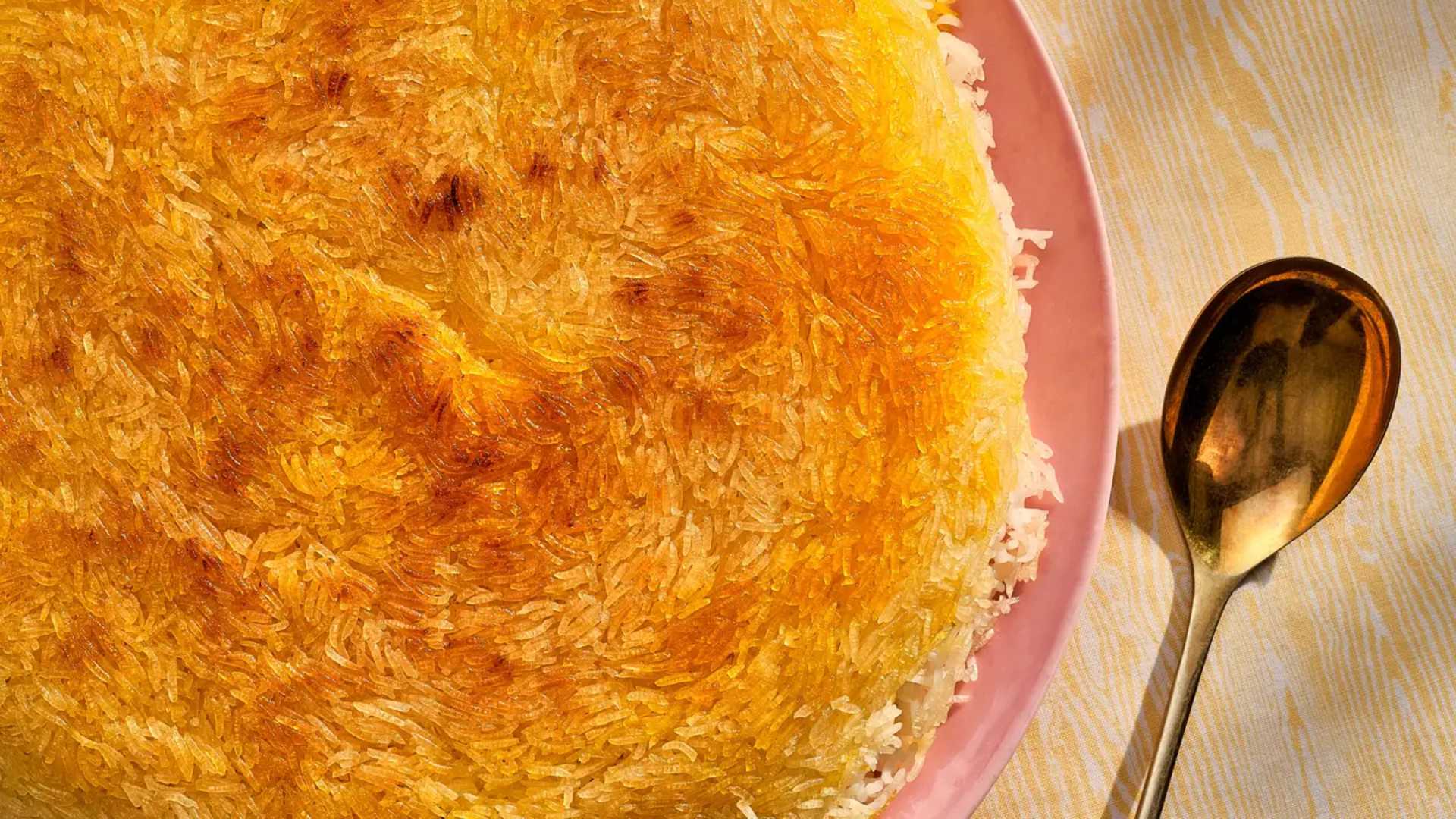
At the center of the Iranian table sits rice. Yet, this is no ordinary grain. Chelow—plain white rice—is steamed until each grain is distinct; at the very bottom, a fried, crispy golden crust forms: the tahdig. Tahdig is not a mere byproduct; it is the most coveted element of the meal.
Sociologically, tahdig represents the thin line between scarcity and abundance. The meticulous care taken to prevent the rice from burning serves as a reminder of the invisibility of domestic labor. In Iran, for centuries, the labor of the kitchen has largely been the responsibility of women. The perfection of a tahdig is almost always the result of an unseen mastery.
Khoresht: Flavors Fusing Over Time
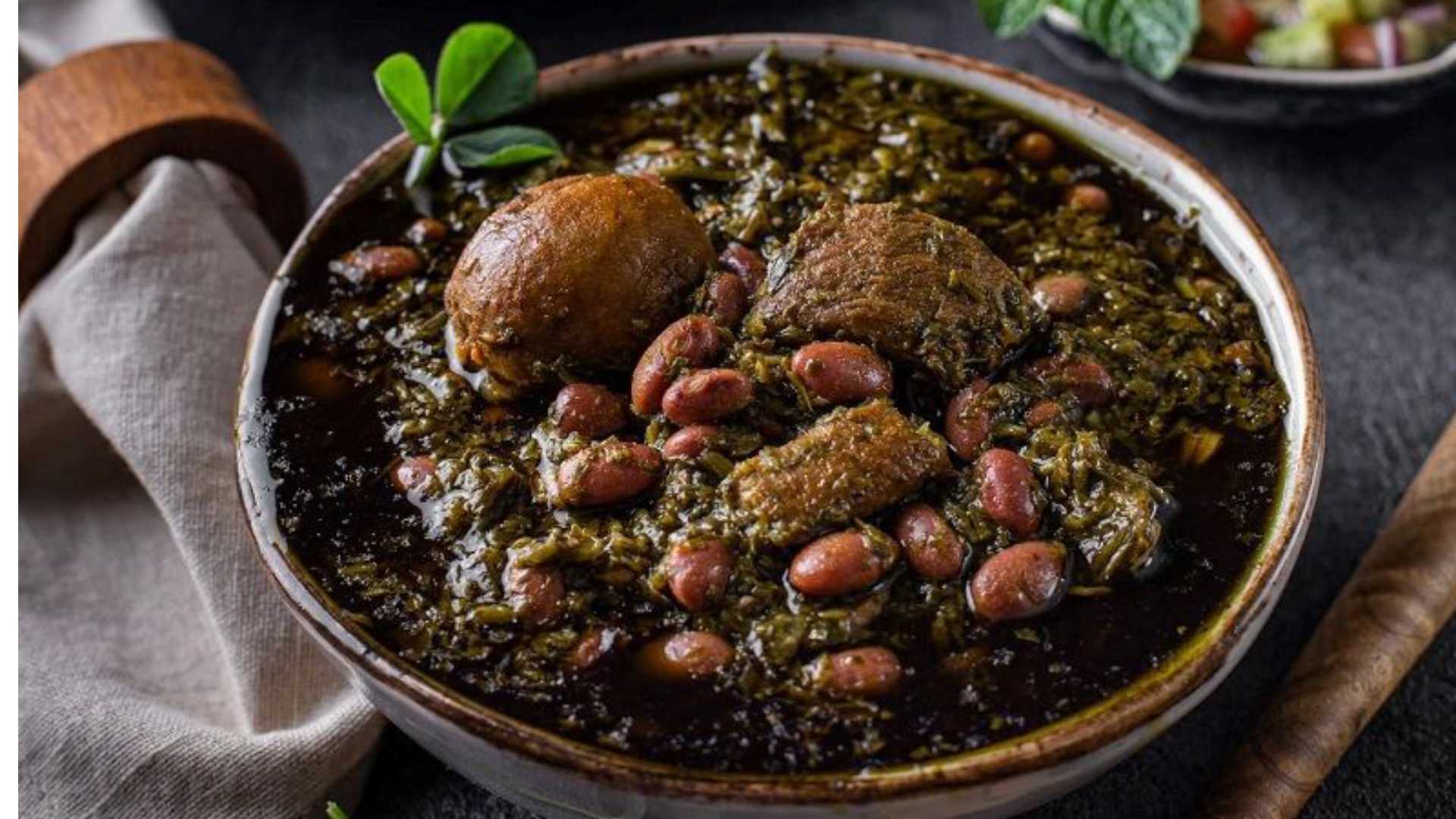
Ghormeh Sabzi, the herb stew, is a type of khoresht that could be considered Iran’s national dish. It simmers for hours with lamb, heaps of parsley, cilantro, green onions, other herbs, and most crucially, Limo Amani (dried Omani lime). The acidity of the dried lime, the deep aroma of the herbs, and the texture of the lamb meld together over time—much like Iran itself.
Kebab and the Public Sphere
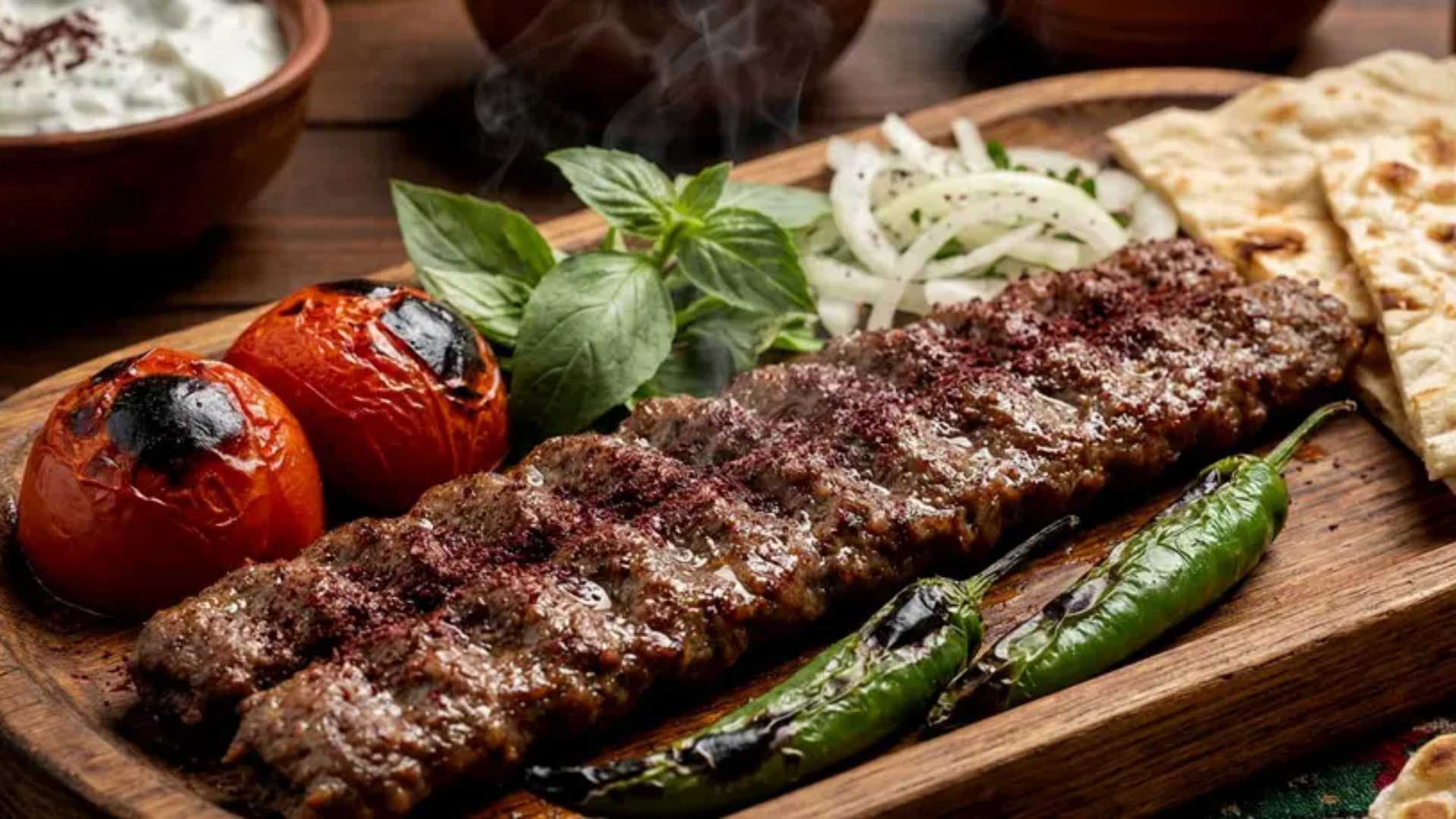
Kebab Koobideh and its variations belong to the public realm. They are associated with the street, the bazaar, and male sociability. The people gathered around the grill simultaneously produce a political public space. Throughout history, teahouses and kebab shops in Iran have functioned as sites of debate and dissent.
In this sense, kebab is more than just meat; it is the smoke of public discourse.
The Embargo: A Kitchen of Poverty and Scarcity
Following the 1979 Islamic Revolution, Iran grappled with increasingly severe embargoes and poverty. The weight of these sanctions was felt primarily in the kitchens of the poor and the burgeoning masses of the impoverished. As meat diminished, legumes took center stage. Iranian cuisine survived through its capacity to create rich flavors from limited resources. This is a matter of habitus, as Pierre Bourdieu would put it: a way of clinging to life shaped by material conditions, yet transcending them.
Sofreh: Equality Set on the Floor
The Sofreh is a meal spread upon a cloth laid on the floor. This arrangement creates a spatial organization distinct from the hierarchy of the dining table. Everyone sits at the same level; dishes are in the center; sharing is essential. However, this equality is not always absolute. Age and gender roles within the family dictate who sits where and who serves whom. The table is a microcosm where equality and hierarchy coexist simultaneously.
The Balance of Taste: Sour, Sweet, Bitter
The most defining characteristic of Persian cuisine is the balance of flavors. The sweet-sour profile of pomegranate, the sharpness of dried lime, the floral aroma of saffron, and the acidity of sumac powder work in unison. This balance parallels the general principles of Iranian aesthetics: the harmony of opposites.
This aesthetic sensibility is also evident in classical texts like the Shahnameh, where tragedy and heroism, loss and grandeur, stand side by side. The same tension exists at the table: the simplicity of rice against the richness of khoresht; the coolness of yogurt against the fire of the kebab.
Diaspora and Globalization
The Iranian diaspora spread across Europe and North America, particularly after 1979. “Tehrangeles” restaurants in Los Angeles and modern Iranian eateries in London have merged traditional recipes with contemporary presentations. These spaces are arenas for the negotiation of identity.
In the diaspora, Persian cuisine becomes a vessel for nostalgia.
A Fesenjan cooked at home is not just a meal; it is the reconstruction of a lost geography.
Women, Recipes, and Silent Archives
The true archivists of Iranian cuisine are women. Unwritten recipes are carried in memory. Although the domestic kitchen has often appeared to be excluded from the political sphere in modern Iranian history, it is actually the epicenter of cultural continuity.
Women’s labor in the kitchen reproduces traditional roles while simultaneously creating a practice of resistance that preserves cultural identity. This contradiction is a reflection of the broader contradictions within Iranian society.
The Table is a Text
To understand Iranian cuisine, knowing recipes is not enough. One must see the historical conditions under which those recipes were shaped, the class practices through which they are reproduced, and the identity struggles they represent.
The Iranian table is a text. In the steam of the rice lies the shadow of empires; in the yellow of the saffron, the desert sun; and in the tartness of the pomegranate, the melancholy of exile. And in the crunch of the tahdig, one hears the sound of how all this historical weight is digested in everyday life.
