


In The Cool Shadow of Disfrutar
I shall begin with a brief summary and a reference to my previous article: Opened in 2012 in the town of Cadaqués on the Costa Brava, north of Barcelona, Compartir declared from its very name: “We shall share.” The plates are meant for sharing.
The trio of El Bulli origin—Mateu Casañas, Oriol Castro, and Eduard Xatruch—do not imitate El Bulli with this stance; instead of striving to be avant-garde, they prefer to return to the roots, to traditional cuisine… Of course, there is now an El Bulli past; they are an emulsion within technique and discipline…
Yes, this return is like a softening against the harsh and intense gastronomic experience of El Bulli. In Compartir, El Bulli’s technical accumulation is not entirely absent, but it is not in the shop window. The plates do not shout, “look what we did.” Rather, they say, “look what we cooked.” In other words, the goal here is to please rather than to shock.
In 2014, Disfrutar, which can be considered the successor to El Bulli, was born in Barcelona as the new project of the Casañas–Castro–Xatruch trio. However, it too is like a correction. In the three-Michelin-starred Disfrutar, which appears at the very top of the world’s best restaurant rankings, technique and spectacle are not sidelined, yet flavor and the act of eating have not been entirely sacrificed to the void.
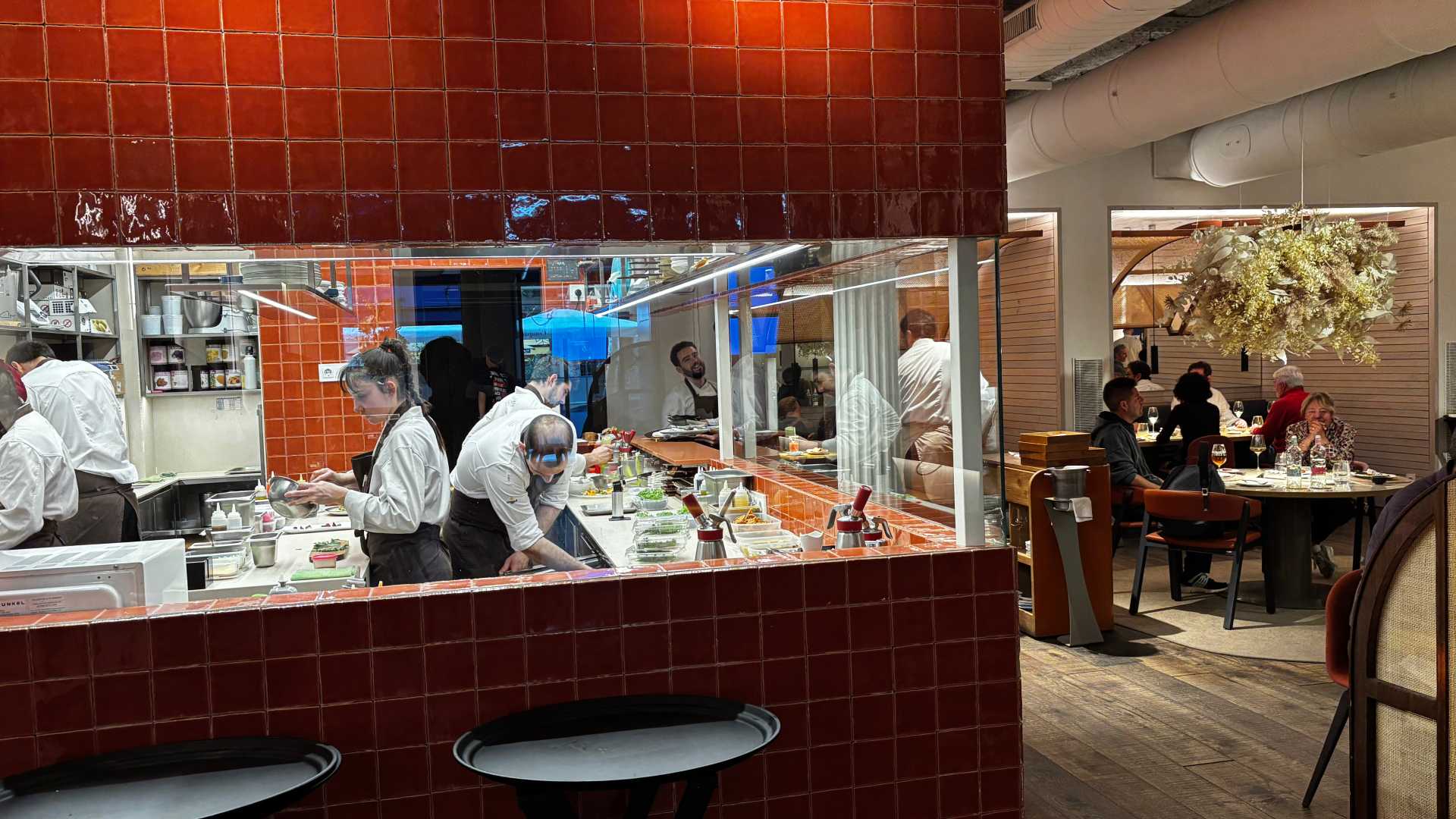
The trio opened Compartir Barcelona in 2022. This time, the shared plates blend into the urban rhythm of Barcelona. There is no hunger for spectacle; there is good service. Technique is certainly present, but it does not overwhelm the plates. Creativity is in play, striving to explode the flavor and maintain balance.
I am certain that you will remember at least one dish you eat here for the rest of your life.
For me, that dish was named Navajas. Navajas con hinojo y salsa meunière (Razor clams with fennel and Meunière sauce).
The first time I ate razor clams in my life was in Menton, France; they were prepared a la plancha and lightly drizzled with olive oil. That was all. I was captivated, and the flavor was etched into my brain. Wherever I saw them, I ordered them. I ate them in Galicia—not better, but at least as delicious as that first time—and I was fascist and conservative enough to claim that they could never be more beautiful than that. Until Compartir. I ordered them every time I saw them. Most of the time, I regretted it because my reference and expectation were that first bite.
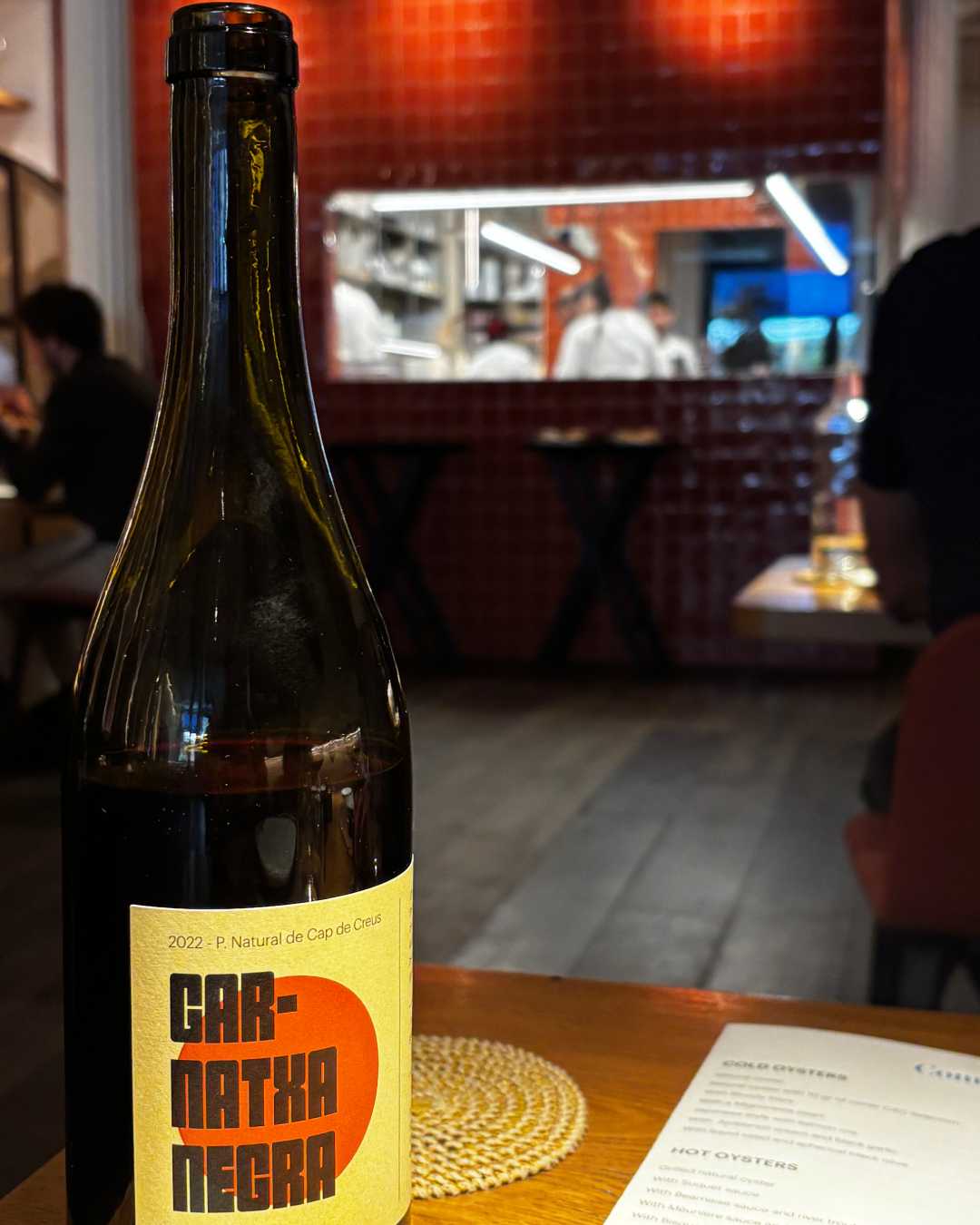
GARNATXA GRIS Cap de Creus 2024
In my view, nothing could be better than that lean a la plancha flavor of Navajas. They must have emerged from the sea just moments ago, be cooked in that sea’s own water, and of course, be cooked at the right temperature for the right duration—neither too little nor too much. Flavored with a good olive oil and a drop or two of lemon… That is all…
In Italy, France, and of course Spain, I tried—with great curiosity and conservatism—beautiful Navajas that had been emasculated by different cooking techniques. Until I tasted the Navajas with fennel and Meunière sauce (Navalles Meuniere) at Compartir. Butter already produces a hazelnut aroma (beurre noisette) in a Meunière sauce, but in this dish, the support and intensity provided by the roasted hazelnuts themselves—used in Catalan cuisine—carried the clam to an entirely different realm. They captured a magnificent harmony and explosion; I was left stunned. That taste was engraved upon my palate and my mind… The throne of the simple Navajas in Menton and Galicia was not toppled, but my conservatism on this matter dissolved.
It is not the exact same dish, of course, but I learned that a conceptually similar version with the same building blocks was previously presented in Disfrutar’s seasonal tasting menu as “navajas cocinadas a la meunière” (Razor clams cooked in Meunière style). This is explicitly noted in the 2024 restaurant tasting reviews: Disfrutar 2024: En la cúspide de los elegidos. Disfrutar 2024: En la cúspide de los elegidos. – Complicidad Gastronómica
Among the plates I shared with two new friends during lunch, all were good or very good, with the exception of the duck magret (Magret Pure Carbas).
To summarize:
We began with the Shrimp salad with light pepper foam and tomato oil (Ensalada de gambas con espuma ligera de pimiento y aceite de tomate). The flavor was not as striking as its appearance, but it was satisfying for a cold starter. I would have preferred it to be more acidic, but frankly, I had no complaints about what was served.
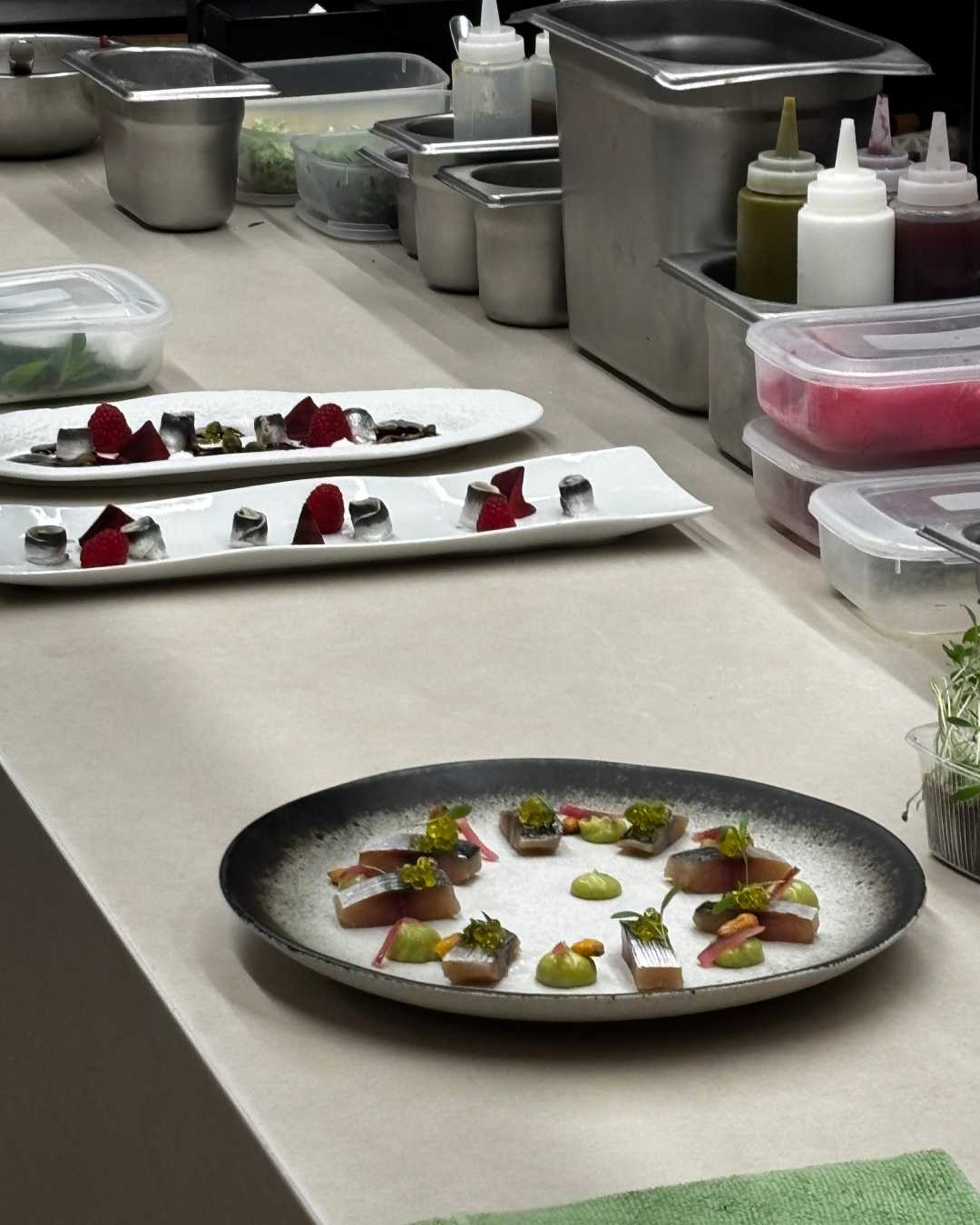
We continued with the Marinated sardines with raspberries, beetroot, and pistachio (Sardinas marinadas con frambuesas, remolacha y pistacho). The colors were striking; the portion size was small for our table of three, but the flavor was spot on.
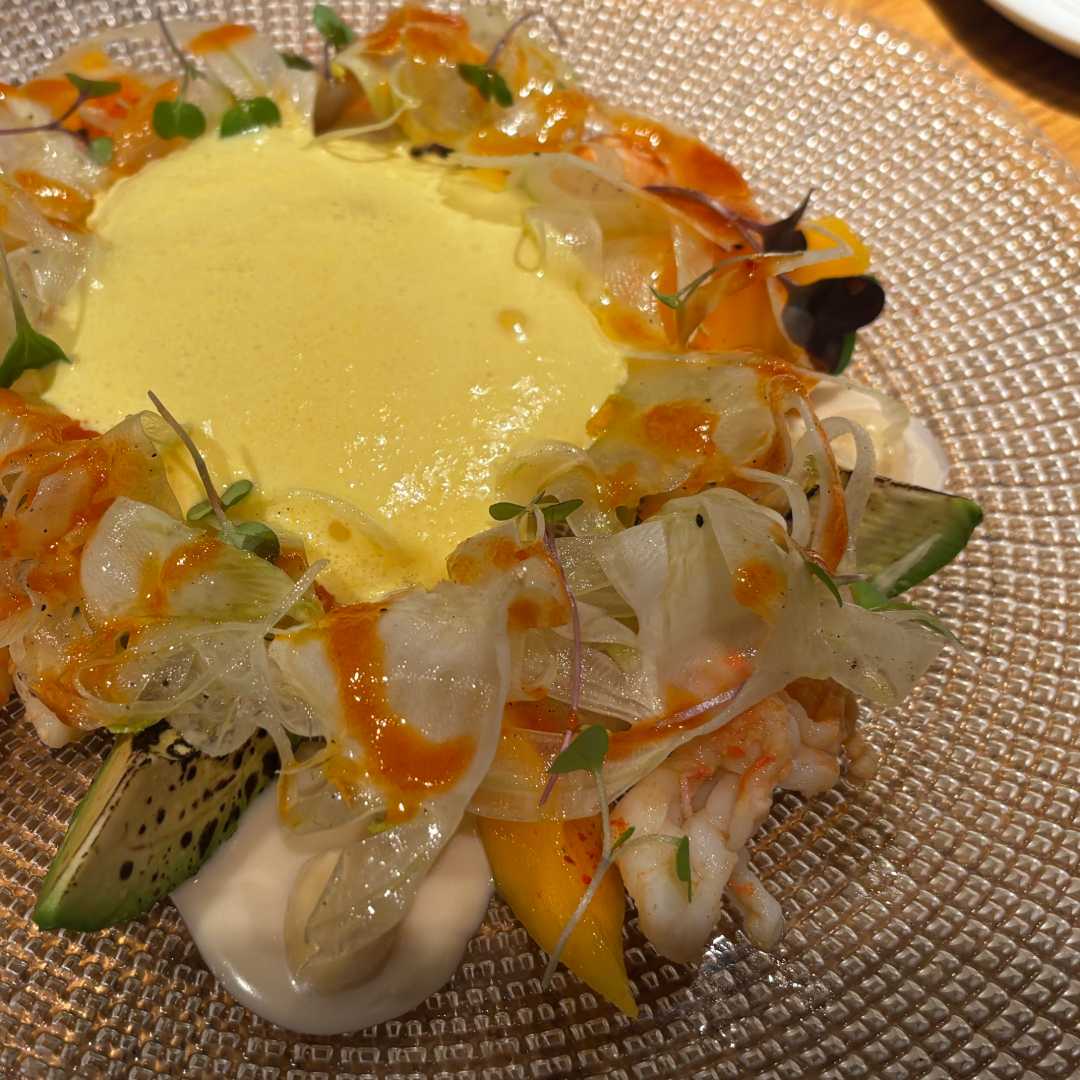
Shrimp Salad with Light Pepper Foam and Tomato Oil
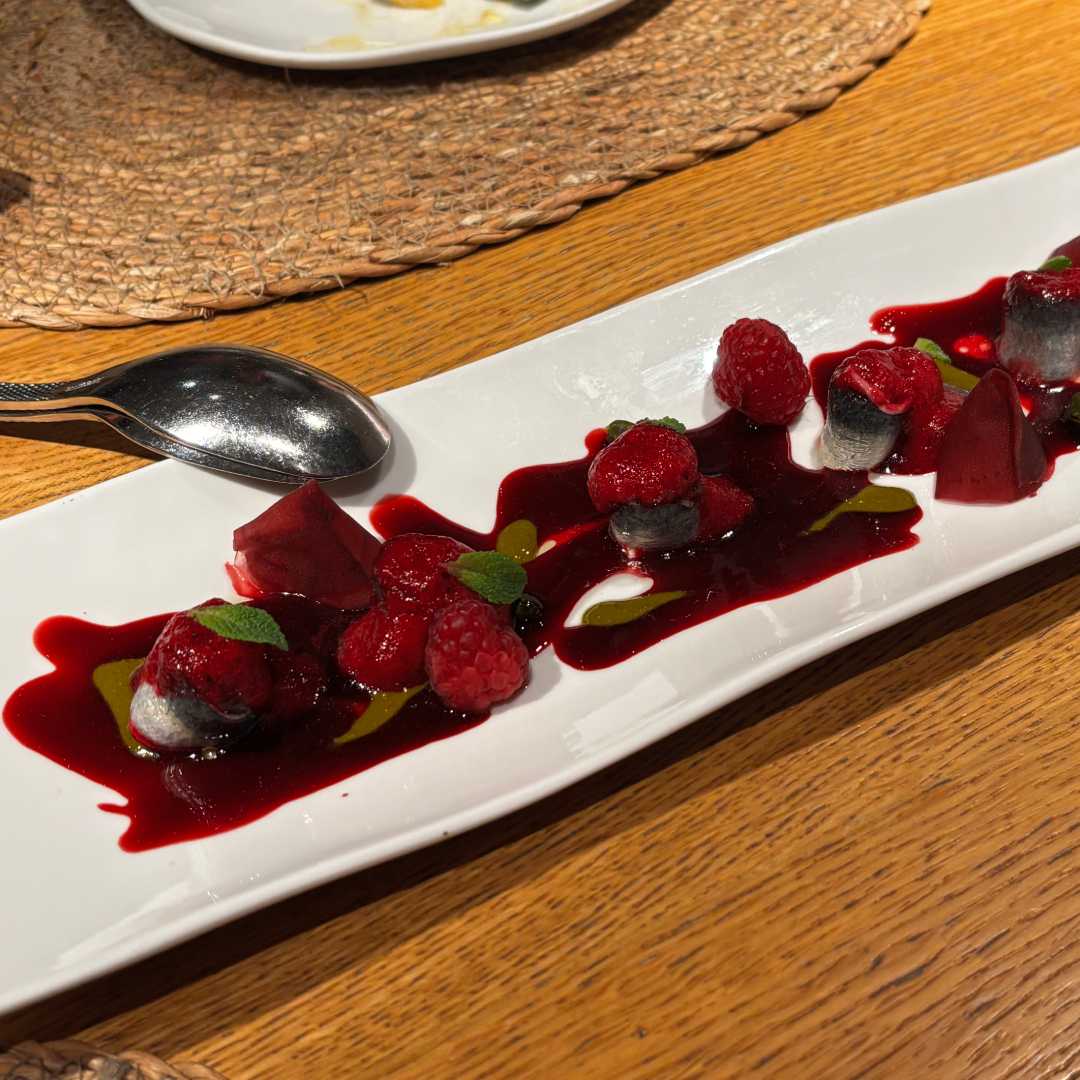
Marinated Sardines with Raspberries, Beetroot, and Pistachio
The Cold seasoned mackerel with ceviche sauce and yellow pepper sorbet (Caballa aliñada en frío con salsa ceviche y sorbete de pimiento amarillo) was again visually wonderful, like an oil painting. The flavor was good, but clearly lagged behind the form. That is why I feel the need to describe the visuality first.
Then, the essence that transcends form landed on the table! Razor clams with fennel and Meunière sauce (Navajas con hinojo y salsa meunière). I wrote about it above. What I left out is that it looked wonderful. The long, thin clams, resting calmly in the lap of the seaweeds (a brown alga) underneath—which do not contribute much to the flavor—adorned with butter foam, are still before my eyes.
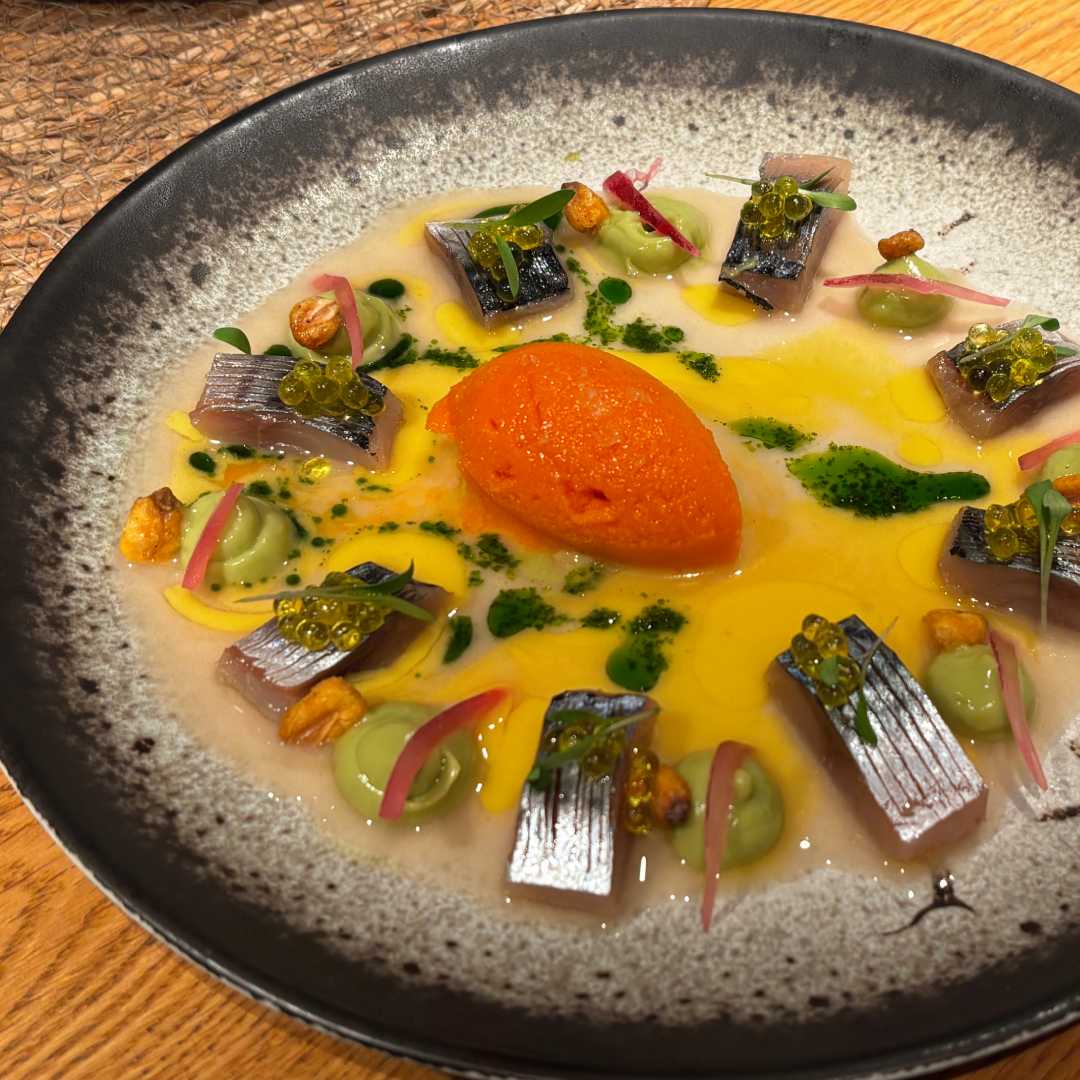
Cold Seasoned Mackerel with Ceviche Sauce and Yellow Pepper Sorbet
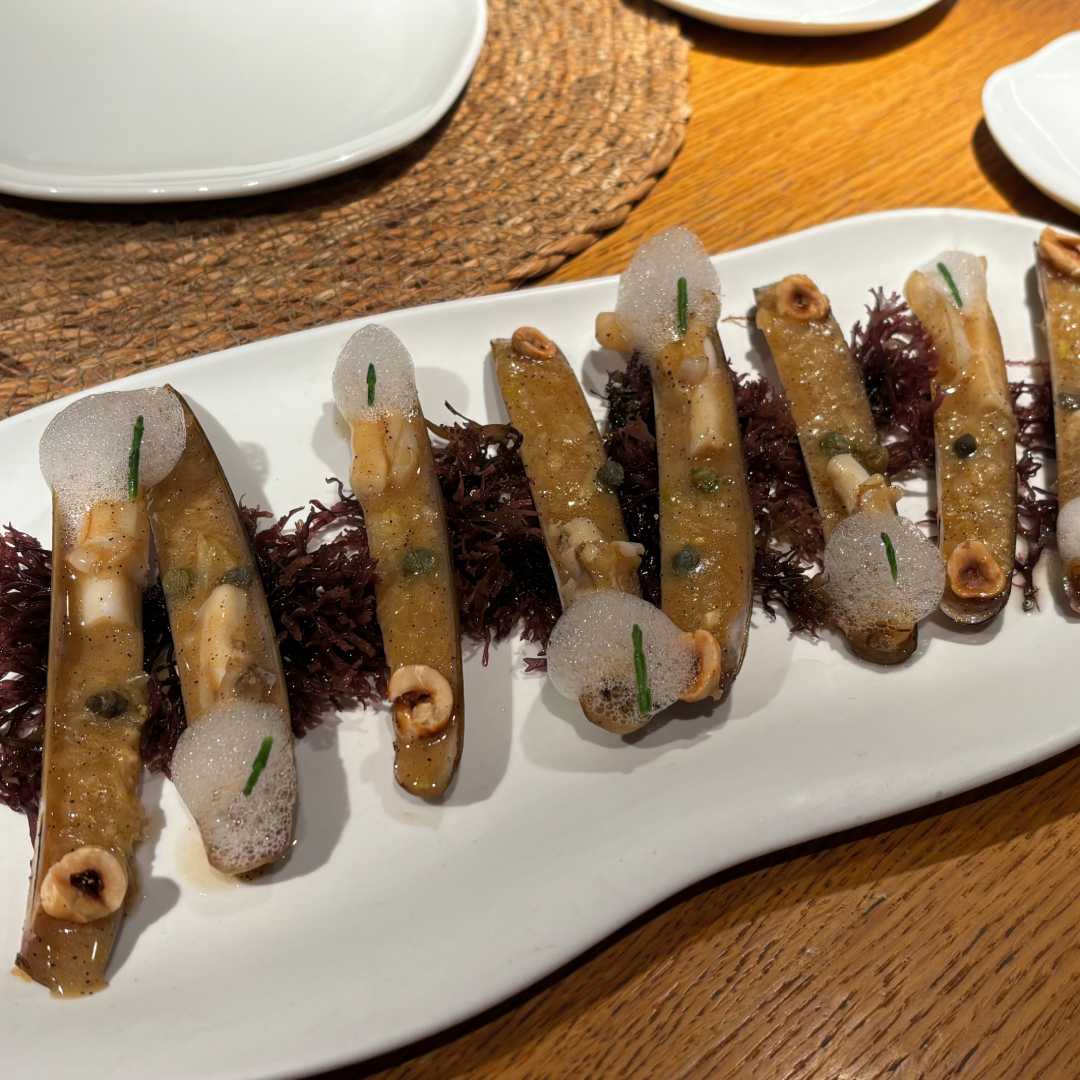
Razor Clams with Fennel and Meunière Sauce
The Fried eggs with marinated salmon, wakame, and citrus vinaigrette (Huevos fritos ilustrados con salmón marinado, wakame y vinagreta cítrica), a creative and very successful version of the fried egg—a classic of Catalan cuisine—was our last stop before the main courses. After eating the first piece of salmon, I looked at the rest of the plate and thought: what is this? Is there more? Fortunately, my other friends were not as gluttonous as I was, and I had more than I needed.
The Compartir version dethroned the fried egg with shrimp served over shoestring fries by La Medusa 73, the companion to the fishmonger stall in Mercat del Ninot. Do not think that way; do not say, “how can you compare such a bar with Compartir!” The restaurants inside the neighborhood markets of Barcelona are among the primary places where you will find the best of traditional Catalan cuisine. There is at least one good spot in almost every market. The most special one for me is, of course, Bar Restaurant Pinotxo, Mercat de Sant Antoni…
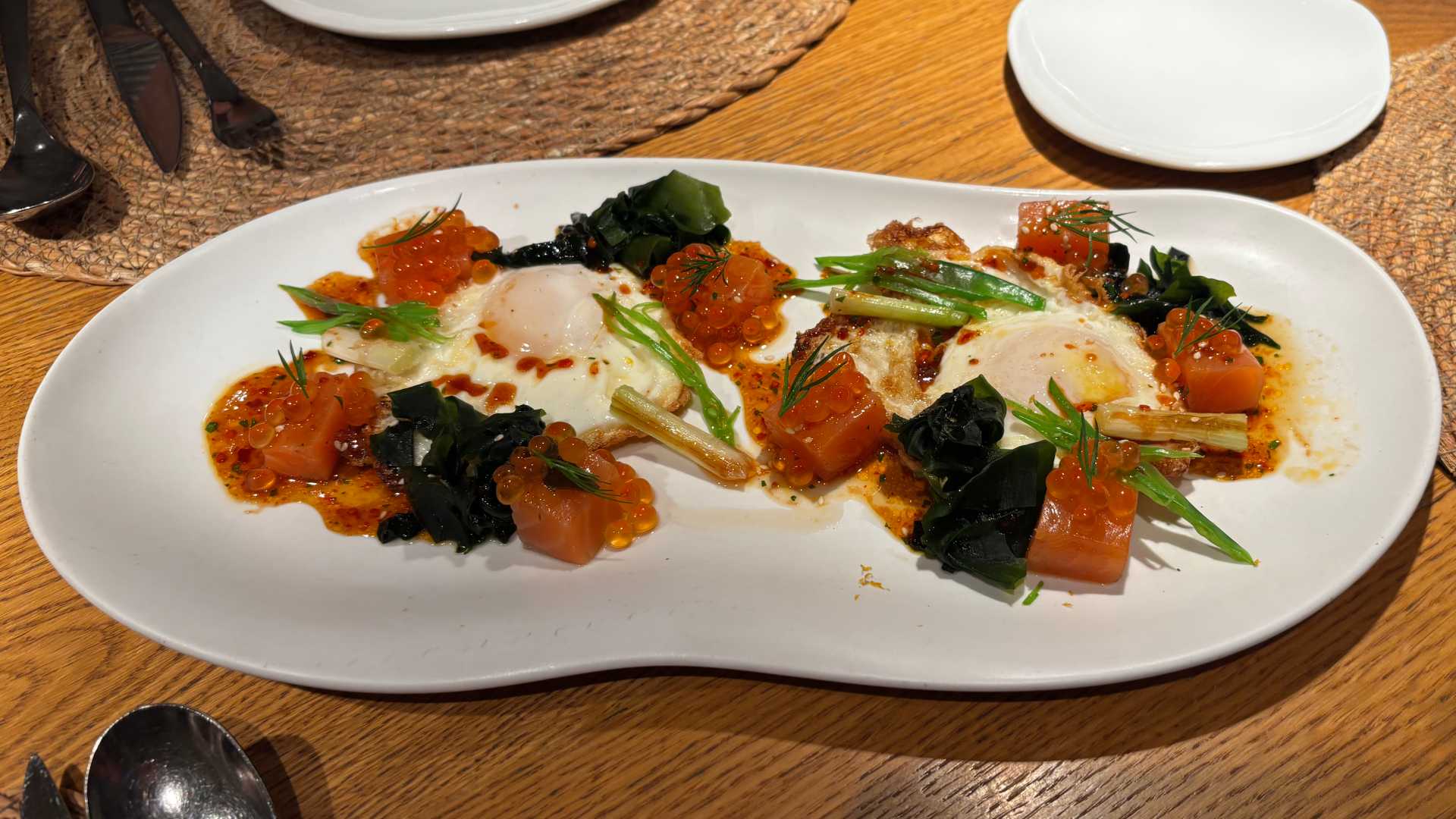
Fried Eggs with Marinated Salmon, Wakame, and Citrus Vinaigrette
The first main course, meant for sharing of course, was the fish: Red mullet with escalivada (on a bed of roasted vegetables) and homemade fresh cheese (Salmonete con escalivada y queso fresco casero). Again, the appearance was literally unique, like a painting. In my opinion, both the escalivada and the fish were overwhelmed by this visuality. It was delicious, but let us say it could not find its intrinsic value due to the form that raised expectations so high.
The final dish, unfortunately, was the only inadequate one. We did not like it and we left it. No, not because we were full or because we were late—definitely not. The Rested duck magret with pumpkin puree and kale (Magret de pato reposado con puré de calabaza y kale) truly became the last one when it lacked crispy skin and the inside felt rubbery.
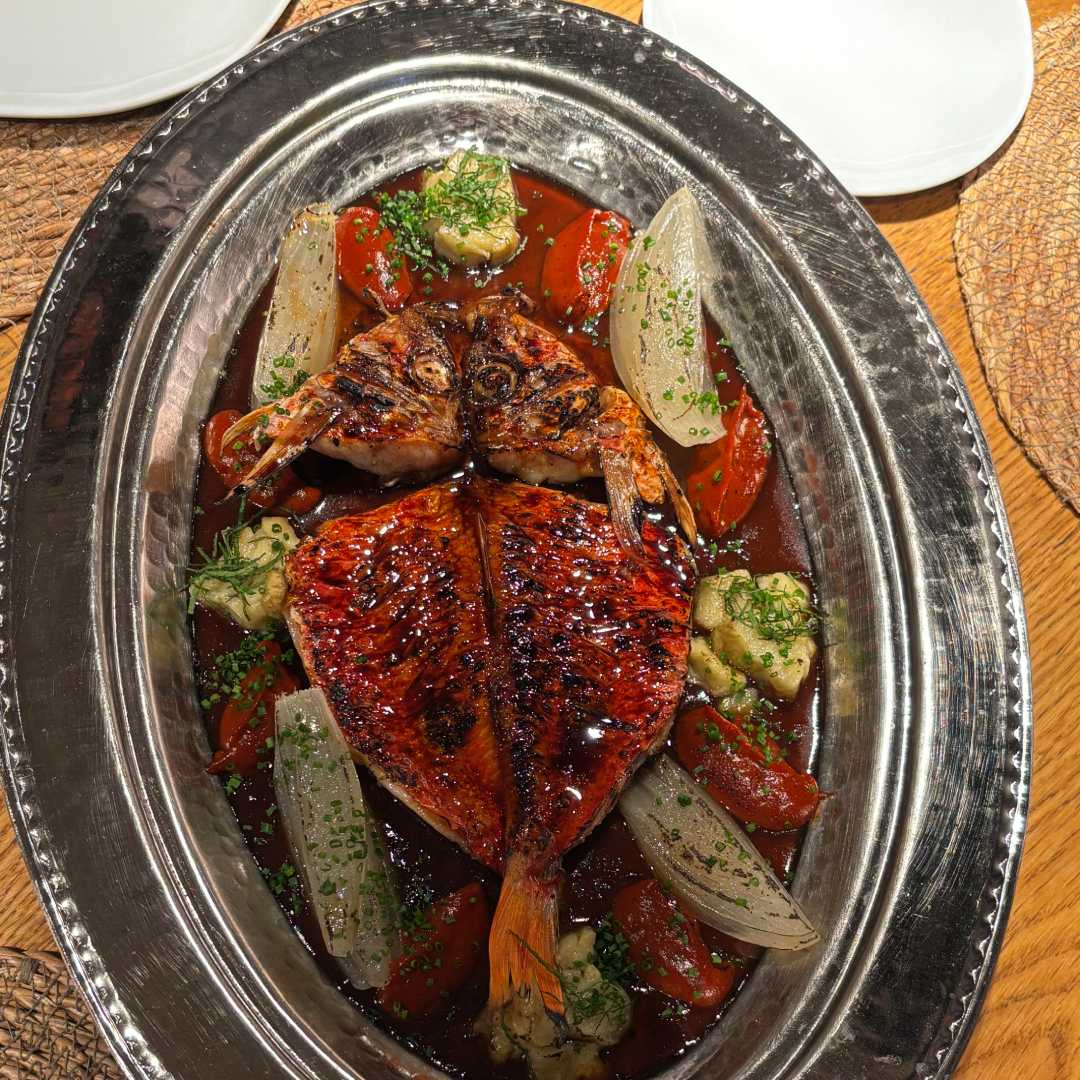
Red Mullet with Escalivada (on a bed of Roasted Vegetables) and Homemade Fresh Cheese
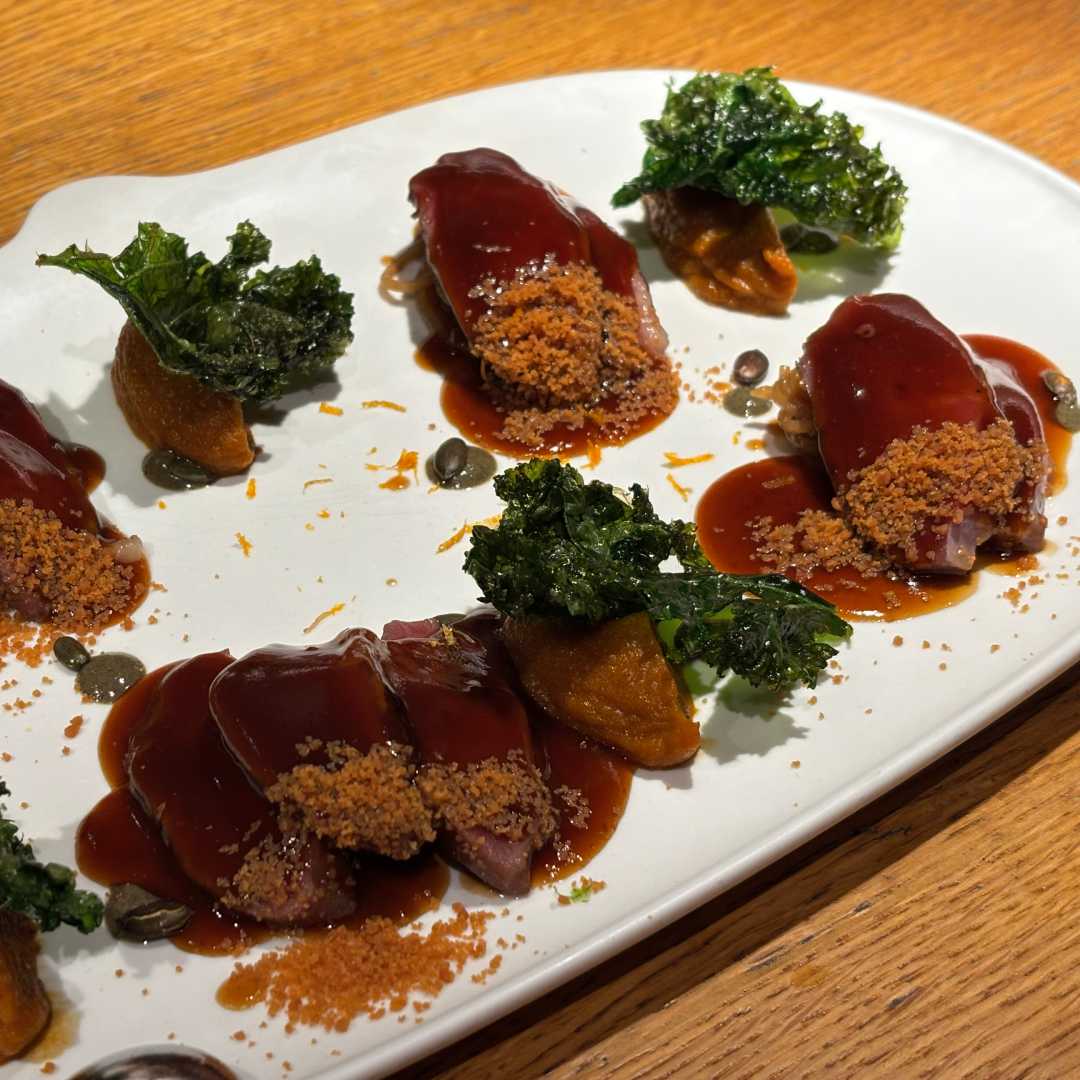
Rested Duck Magret with Pumpkin Puree and Kale
And our wine was finished anyway!
I do not particularly enjoy natural wines. I often have trials and experiences that result in regret. Fortunately, this time things went well, and I believe I am close to discovering the path I am looking for. GARNATXA GRIS Cap de Creus 2024 opened this path for me; it was a beautiful exception. I think I understand what I like.
I cannot go without mentioning that the online sales price of this wine is 17€. It is a perfect match for United Plates’ recommendations for wines under 20€. Of course, its price also makes the wine more likable.
