


From Foça’s Ionian winds to Aheste’s calm tables, where history flavors each bite and the sea remembers Marseille
The mild days would come to the terraces,
Stretching their measures of season.
Leaves filled the back window to the brim.
Can a person love two people at once?*
— Cemal Süreya
I have no answer to those lines in the “Karne” poem.
But if one addresses the matter from geography and place, then of course there is an answer.
Suppose I ask: which Foça do you love more?
Old Foça? Or New Foça?
If I were to cast a vote, I would stamp my seal on Old Foça.
Among the reasons shaping my decision: Old Foça’s effort to remain itself, its authentic streets, its market, and its higher level of restaurants.
In the province of Izmir, among the districts that serve as alternatives to Çeşme, there is Foça.
Let me tell you a bit about Foça, if you like.
The ancient name of Marseille is Massalia. Around 600 BCE, mariners from Foça, on an expedition into the western Mediterranean, settled in the place where today’s Marseille lies, founding a colony there.
Marseille was founded by Foçalı sailors.
Therefore Foça may be considered the first Ionian gate opened to Western Europe.
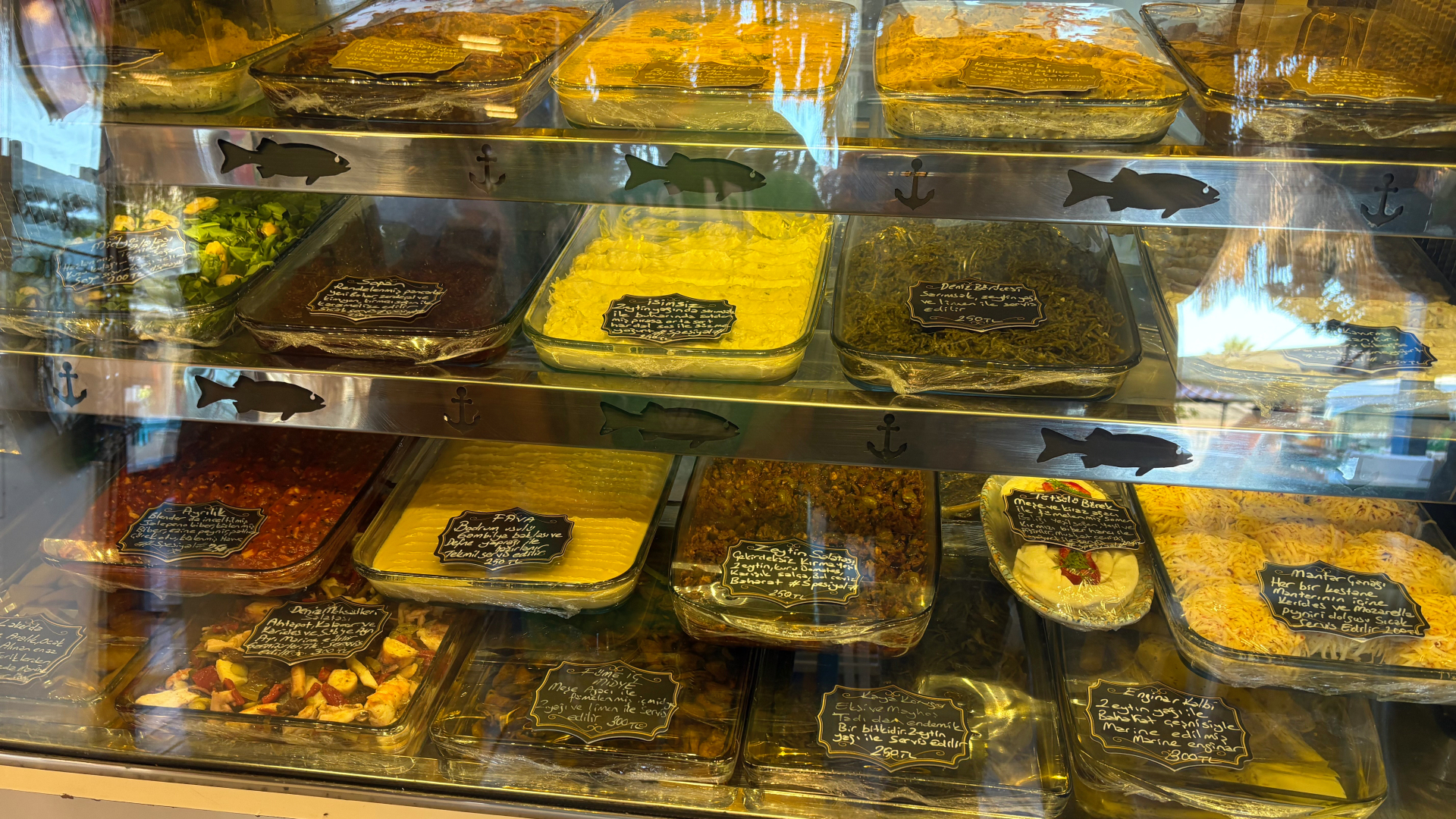
Having touched briefly on its history, if you wish to enjoy something inside the bazaar of Old Foça, you can settle in at Aheste Volkan’ın Yeri.
On its menu are cold meze varieties, restaurant classics, signature dishes, hot dishes and intermediate courses.
Alcoholic beverages are also available.

Zamska

Susaki
First we order Zamska.
Black garlic, sundried tomato, capers and walnut. A mezze with integrity.
Then comes Susaki.
Sesame roasted in butter, charred “topan” eggplant, and a special local olive‐oil sauce. Balanced, delicious.

Ayrılık

Tarama
The mezze named Ayrılık sprang into being after the chef’s separation from his spouse. It contains roasted kapia pepper, basil, tomato, eggplant, nigella seed, a hint of pepper, tahini, and two kinds of cheese. If pared down—omitting a few ingredients—it might be even more effective.
The Tarama prepared with seafood is 50% squid, 50% octopus, with light vinegar, olive oil, garlic, dill, and bay leaf. The salt level is noticeably high. If that could be adjusted to neutral, I would order it every time I come.

Salad

Grilled Octopus
At our table later there was a salad: basil, purslane, arugula, lettuce, tomato, red onion, red pepper, parsley, carrot, red cabbage. Fresh ingredients count.
The grilled octopus, served with a marinade, had nicely caramelized arms, and the surface charring was quite good.
Inside, medium softness; outside, a delicate crisp.

Fried Squid

Grilled Sardines
The squid was fresh, though it had absorbed a bit of oil. But not rubbery. Thanks to the creamy sauce it had slight crispiness. The contrast was not bad.
Finally, we order sardines—in both grilled and fried forms—typical of the Black Sea region.
Their oiliness was ideal. The inside remained soft and juicy. No dryness.

Fried Sardines
All told, if I were to make a general evaluation: despite some roughness in salt calibrations, considering the variety of plates, the quality of ingredients, the ability to catch contrasts, this place earns an easy place among the few establishments that will not disappoint your palate.
Enjoy.
