


The Political Economy of Food from Polanyi to the Present
In the modern world, food is most often narrated as a matter of personal choice, an individual pursuit of health, an expression of cultural identity, or an element of social media aesthetics.
Every prepared plate, every shared photograph, and every consumed menu is presented as though it were the natural outcome of individual free will. Yet this narrative of freedom is one of the fundamental illusions produced by what Karl Polanyi described nearly a century ago as the Great Transformation.
In The Great Transformation (1944), Polanyi demonstrates with remarkable clarity that the modern market order did not emerge from the organic evolution of societies. Rather, it was constructed as a historical project of social engineering, instituted through deliberate state intervention. Markets are not the products of spontaneous, natural processes; on the contrary, they are politically constructed institutions. When we examine the foundational pillars of today’s food system, we observe that the dynamics Polanyi identified continue to operate with striking fidelity.
The Commodification of Food
Today, the production, distribution, and pricing of food have moved far beyond biological necessity. They are instead outcomes of a complex and multilayered economic order. Polanyi’s concept of “fictitious commodities”—that is, domains that are treated as commodities despite not being commodities by nature—offers a particularly powerful analytical lens for understanding food systems. Like labor, land, and money, food is not inherently a commodity. Yet it has been commodified under the structural imperatives of capital accumulation.
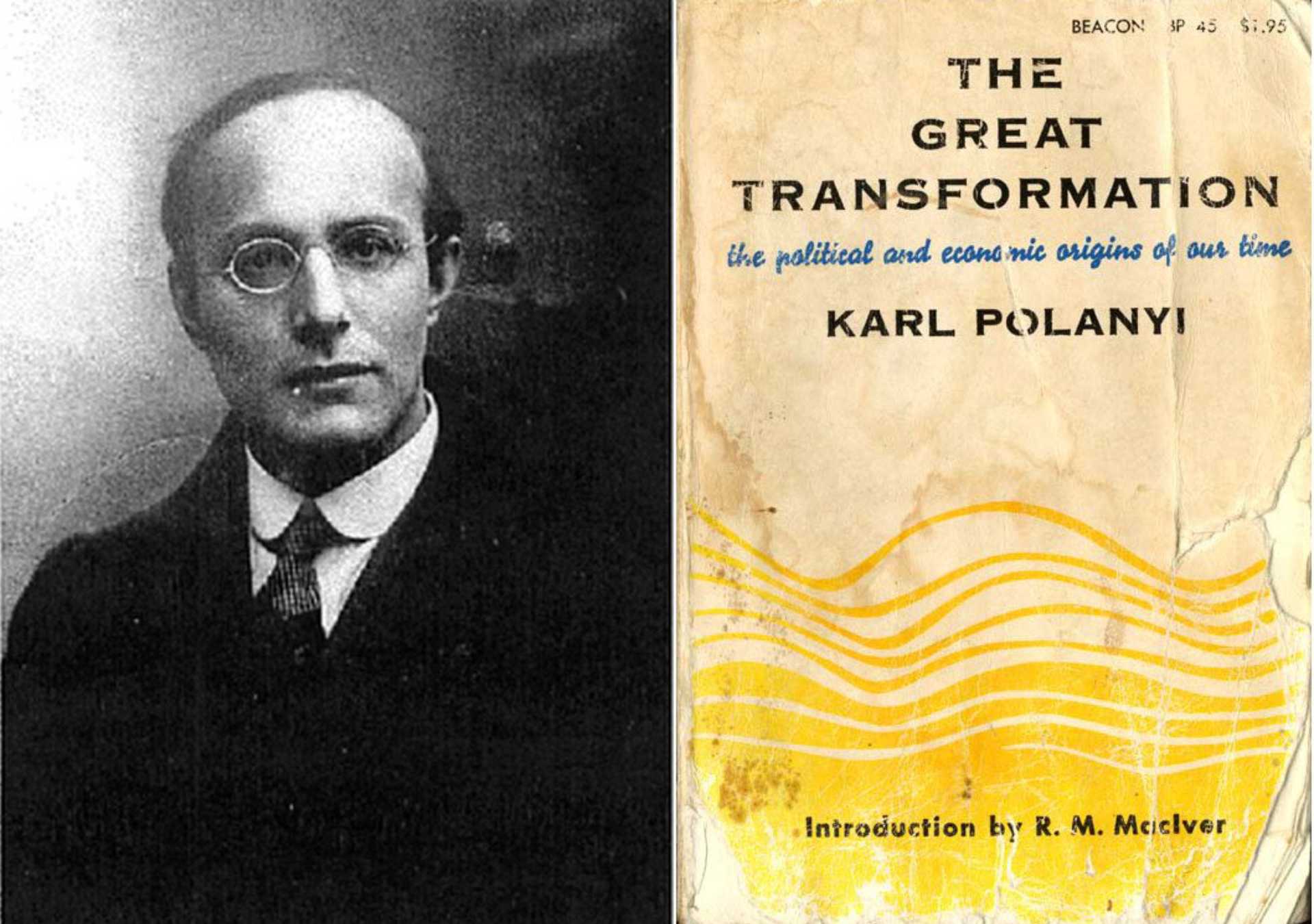
Karl Polanyi & The Great Transformation
This process of commodification transforms agricultural production from a merely economic activity into a profound social and ecological fault line. Food no longer serves solely to meet basic human needs; it becomes one of the principal commodities through which profit motives are realized.
Economists and social theorists working within Polanyi’s intellectual tradition have further illuminated this process. Fred Block and Margaret Somers (2014) emphasize that market-centered systems are never truly “self-regulating”; rather, they require continuous state intervention to function. This reality is especially evident in food markets. For example, financial speculation often shapes grain prices more than harvest volumes (Clapp, 2014).
Here we encounter one of the most destructive dimensions of the market society Polanyi foresaw: the bread of a society becomes tethered to the volatility of global financial markets. As financial capital plays an increasingly decisive role in determining global food prices, the very foundations of global food security are undermined.
This market logic also directly shapes the institutional framework that organizes contemporary dietary patterns. Nancy Fraser contends that neoliberalism restructures social reproduction processes—such as housing, healthcare, caregiving, and nutrition—based on market demands (Fraser, 2016). What is at stake, then, is not merely the marketization of production but the subordination of life itself to economic rationality.
The Ideology of Healthy Eating
Within this context, the ideology of “healthy eating” ceases to be a collective responsibility and becomes an individualized obligation, shaped and disciplined by market forces. The rising cost of healthy food, the mass production of cheap calories by fast-food chains, and restricted access to fresh food in low-income neighborhoods cannot be explained through individual choice. Polanyi described these conditions as structural indicators of the market’s coercive expansion into social life.
Polanyi also insisted that as markets expand, societies inevitably develop protective responses. Every market constructed through intervention generates its own counter-movement. Today, this counter-movement is visible in the field of food. Movements such as La Vía Campesina articulate a political stance grounded in food sovereignty, defending the right of societies to produce, distribute, and consume their own food (Via Campesina, 2003). From a Polanyian perspective, these movements represent organic defense mechanisms against the destructive effects of the market on society and nature.
Similarly, the Slow Food movement introduces a cultural dimension to Polanyian thought by framing food as a form of cultural heritage rather than a mere commodity (Petrini, 2001). The proliferation of local cooperatives, collective access to affordable food, and efforts to treat food as a commons (Maye, 2025) constitute further expressions of this counter-movement. Mobilizations against genetically modified organisms likewise reflect attempts to re-establish the link between food security and ecological sustainability.
This structural transformation has become clearly visible not only in production but also in everyday dietary practices. As demonstrated in Raj Patel’s Stuffed and Starved (2007), the contemporary food system simultaneously produces both excess and hunger.
On the one hand, we encounter epidemics of obesity and diabetes; on the other, geographies of hunger and malnutrition. In some countries, these two conditions coexist, pushing food security into a paradoxical impasse.
From a Polanyian perspective, this contradiction stems from the very nature of the system itself: market logic prioritizes maximum profit rather than social needs. As a result, cheap food is based not on nutritional value but on rapidly produced, low-cost, industrial products (Schlosser, 2001). While healthy eating increasingly becomes a class privilege, the dietary regimes imposed on low-income groups are filling yet systematically unhealthy.
Food regime theory further deepens Polanyi’s analysis. Harriet Friedmann and Philip McMichael examine the global structure of agriculture historically and show that today’s “corporate food regime” is governed by multinational corporations (Friedmann, 2005; McMichael, 2013). In this regime, the decisive actors are not nation-states but retail giants, seed and agrochemical monopolies, and financial institutions. Fundamental sources of life such as land, water, seeds, and labor fall under the control of these structures. In the face of this inequality, Polanyi’s notion of society’s need for “self-protection” becomes all the more urgent.
Industrial Organic Food!
When nutrition culture is understood as a domain shaped by the market, it becomes clear that healthy living trends themselves are market products. Julie Guthman (2004) demonstrates how the industrialization of organic food marginalizes small-scale producers and transforms the “organic” label into a marker of prestige.
This process allows for a Polanyian reinterpretation of Pierre Bourdieu’s (1984) concept of cultural capital: dietary practices become visible expressions of social class.
Taken together, this intellectual tradition reaffirms Polanyi’s warning from a century ago. When the market occupies the center of society, society becomes subordinate to it. Food no longer merely nourishes; it classifies, excludes, and constructs hierarchies. For this reason, gastronomy must be understood not only through taste, aesthetics, or tradition, but through political economy. Food is among the most critical commodities in the process of capital accumulation, and analyzing food-based accumulation necessarily places class compromise and class conflict at the center of inquiry.
History and Power Relations on the Plate
The picture that emerges is unmistakable. The modern food system is not a matter of choice; it is a structure. It is not simply a culture but a political economy. Polanyi and his intellectual successors lead us to look at the table differently. Behind the food that arrives on our plate lies a history, a set of power relations, and an ongoing struggle.
Perhaps today more than ever, we need to understand this struggle. For food does not merely sustain life; it also shapes the kind of society we inhabit and the kind of society we aspire to build. From a Polanyian perspective, the question of “what we eat” is inseparable from the questions of “who we are” and “what kind of world we wish to live in.”

